The Evolution of Crypto Capital Markets

A look into how crypto fundraising has progressed from Initial coin offerings (ICO) to Initial exchange offerings (IEOs); including returns by exchanges as well as discounts given on private sales and more in this deep dive into the world of "investment banking 2.0".
In January 2012, a software developer by the name J.R. Willet posted a whitepaper in the Bitcointalk forum outlining a mechanism to raise funds for new protocols. The proposal aimed to help emerging ecosystems solve the “tragedy of the commons” problem in open source protocols, and facilitate investments in new development, maintenance, and early community rewards. He later described it at a Bitcoin conference in San Jose:
“If you wanted to, today, start a new protocol layer on top of Bitcoin, a lot of people don’t realize, you could do it without going to a bunch of venture capitalists and instead of saying, hey, I’ve got this idea… We’re going to make a new protocol layer. It’s going to have new features X, Y, and Z on top of Bitcoin, and here’s who we are and here’s our plan, and here’s our bitcoin address, and anybody who sends coins to this address owns a piece of our new protocol. Anybody could do that.”
This idea reimagined the entire fundraising process in crypto. Entrepreneurs would be able to access a global pool of capital while anyone in the world could invest in high growth potential projects without Silicon Valley connections or even accredited investor status.
Willet put his idea to work and raised 5,000 BTC (worth $500,000 at the time) for a new project called Mastercoin, in what was later considered the first initial coin offering (ICO). Mastercoin was later rebranded to Omni, the protocol that eventually powered Tether. (“Omni Tether” still facilitates more stablecoin trading than its ERC-20 counterpart.)
The Ethereum token sale opened the floodgates for ICOs. As ETH rallied in 2017, the fundraising mechanism soared in popularity, driven by investors and entrepreneurs that saw easy access to capital and the chance to make astronomical, and liquid returns.
Evolution of the token sale
As the crypto markets cooled off in 2018, so did the concept of directly selling a token to the public via an ICO. Many retail investors that purchased tokens during the run-up lost significant sums of money on their investments.
Regulators took note and have since started to pursue enforcement actions against projects that conducted token sales they allege amounted to unregistered securities offerings. While billions of dollars were raised over the first two years of the ICO boom, demand for tokens released by projects has dried up, and with it new ICOs. Most protocol funding has now moved to the private markets, with teams exploring new options for distributing their tokens upon mainnet launches.
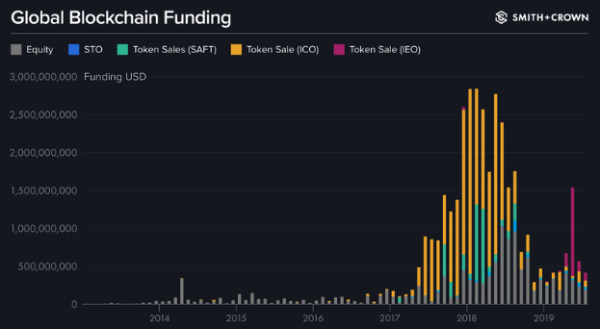
Source: Smith and Crown
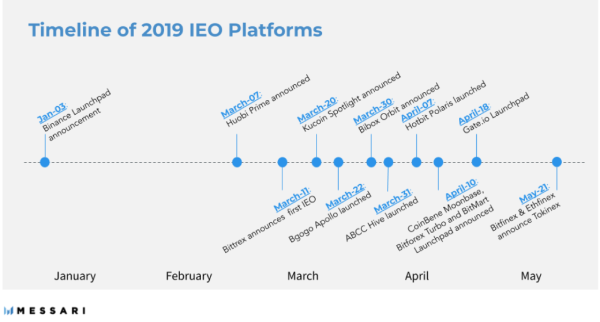
The primary evolution has been away from ICOs and towards “IEOs”, Initial Exchange Offerings. IEOs burst onto the scene in January of this year after Binance announced they would sell a new token every month through its new “Launchpad” service. Since then, we have seen more than 250 such sales across 20 different exchanges, as competitors rushed to capitalize on the new trend as well.
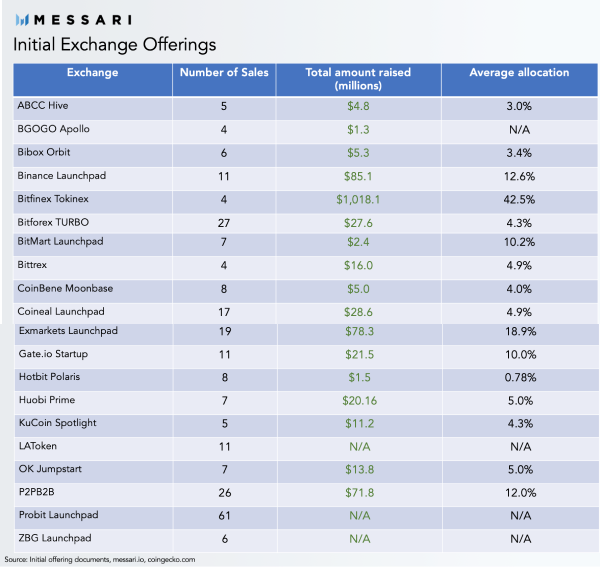
After peaking at around 100 sales in April and May of this year, new IEOs have cooled somewhat. Still, this fundraising mechanism seems to have staying power as it comes with a) an implicit stamp of approval and vetting from a major exchange, b) a guaranteed exchange listing and liquid market from Day 1. Although IEO activity dropped significantly in Q3, a number of larger sales are anticipated in Q4.