State of Compound Q4 2021


To expand on this report, we held a live Crowdcast event featuring Dustin Teander, Sami Kassab, and Getty Hill, co-founder of GFX Labs and 2021 Compound Grants Committee member. View the full recording now or read the full transcript here.
Introduction to Compound
Launched in September 2018, Compound is a leading interest rate protocol built on Ethereum that enables users to permissionlessly borrow and lend assets from a pool of collateral. It sets interest rates for those assets algorithmically using an interest rate model based on the proportion of assets lent out, which it calls the utilization ratio. Compound launched its V2 protocol in May 2019, which introduced additional assets, individual risk models, and smart contract gateways for each asset, among other features. In April 2020, Compound replaced the administrator of the protocol with community governance, empowering COMP token holders to take control of the protocol. In June 2020, Compound began distributing COMP to users via a pioneering liquidity mining program reserving 42% of the total COMP supply to be distributed to users over the next four years.
Compound Markets - Macro Overview
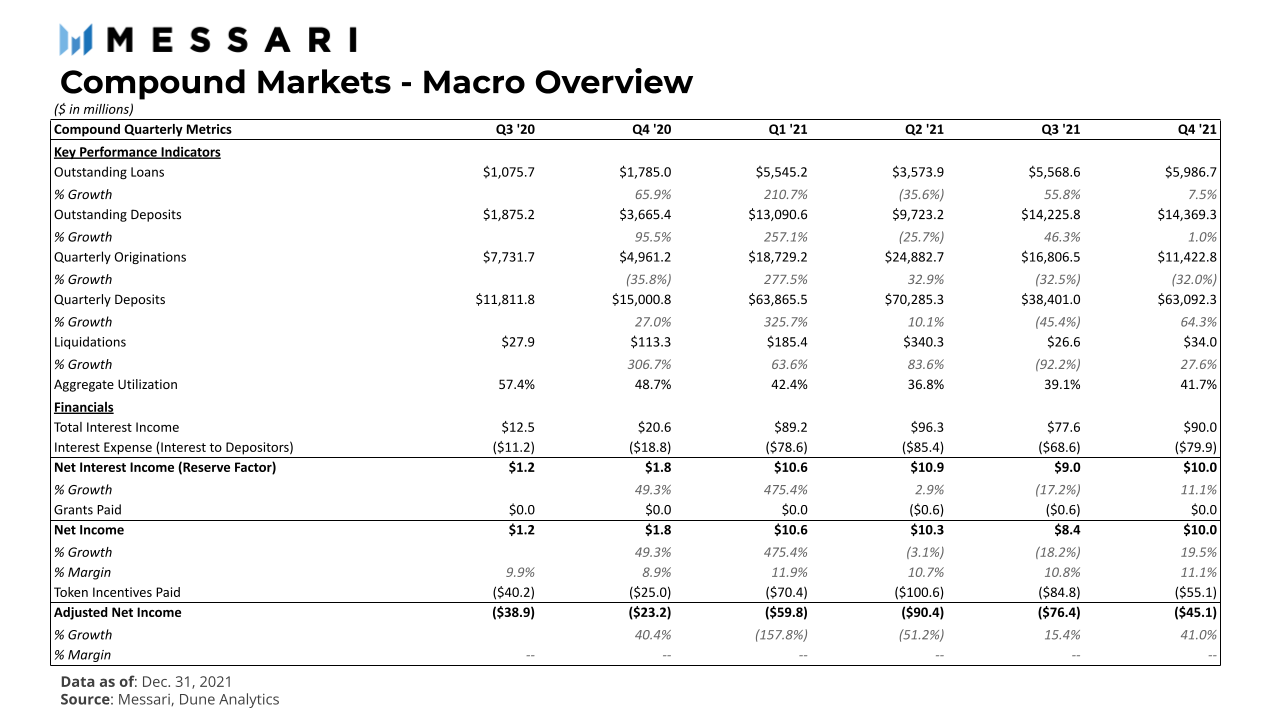
Fueled by strong overall market conditions that saw two all-time high breakouts from Bitcoin in Q4, Compound closed the quarter with quarter-ending highs in several key categories - namely outstanding loans and outstanding deposits.
Strictly looking at quarter-ending figures, outstanding loans and outstanding deposits saw modest growth at 7.5% and 1.0%, respectively. Net income grew over 19% as market conditions dramatically improved from Q3, which attracted new borrowing demand, driving increases in interest income (+11%) and liquidation income (+27%).
Plaguing the quarter-ending figures, however, are two key periods worth noting. On the quarterly close date of Q3, the COMP distribution bug caused roughly $3B worth of closed loans and withdrawn deposits. As a result, Q3 quarter-ending figures drastically underrepresent the state of usage of Compound at the time. Comparison of the underrepresented Q3 figures to quarter-ending Q4 figures masquerades modest declines in usage as modest growth.
Upon resolution of the COMP distribution bug in mid-October, capital quickly reestablished prior levels of usage at approximately $18B of deposits and over $7B of outstanding loans. Capital levels remained at these levels until late November when broader crypto markets began to sell off causing leverage demand and collateral deposits to wane going into the last month of the quarter. As such, Q4 quarter-ending figures represent a state of a slow decline of usage as opposed to the modest growth reflected in the quarter-to-quarter figures.
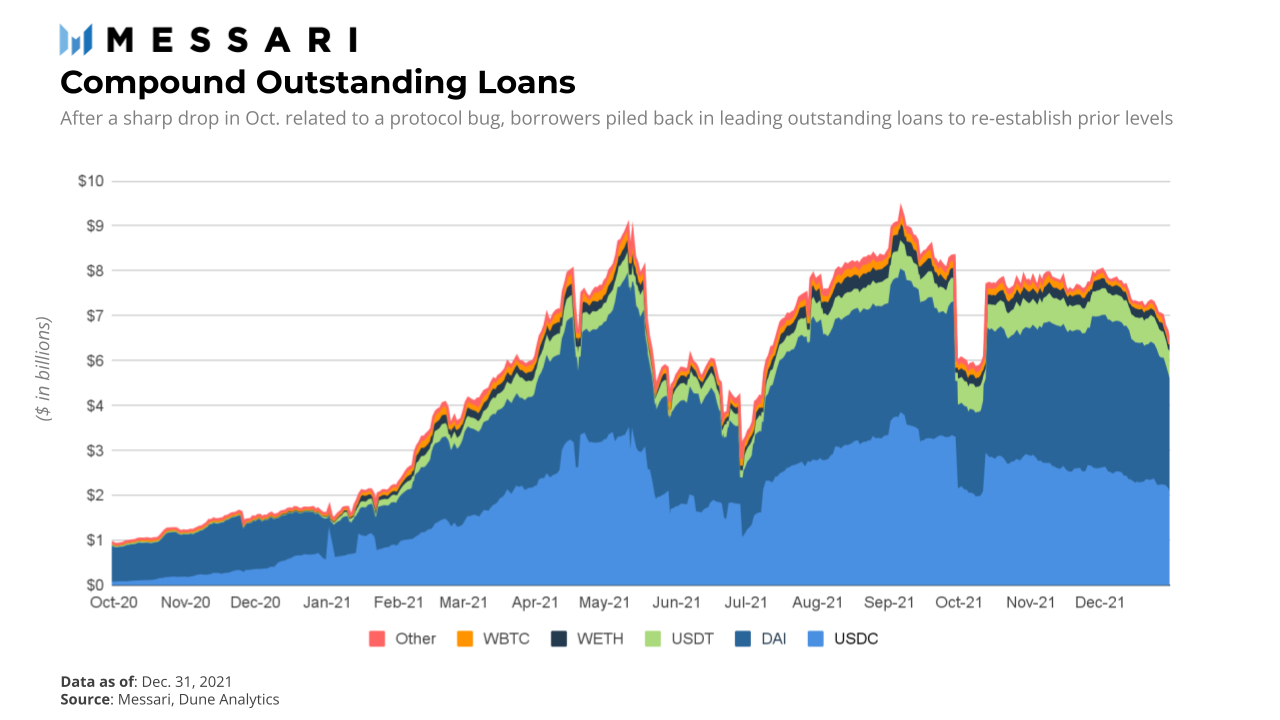
Outstanding Loans, while up 7.5% on the quarter, are down 23% from the highs established in early December. Loans remain predominantly in stables (USDC and DAI) as borrowers overwhelmingly favor stable forms of debt over volatile debts. During the contraction in borrow demand across December, DAI exhibited less overall loan contraction (-23%) than the more favorable borrowed USDC (-30%). As a result, DAI surpassed USDC as the most heavily borrowed asset on Compound to end the quarter.
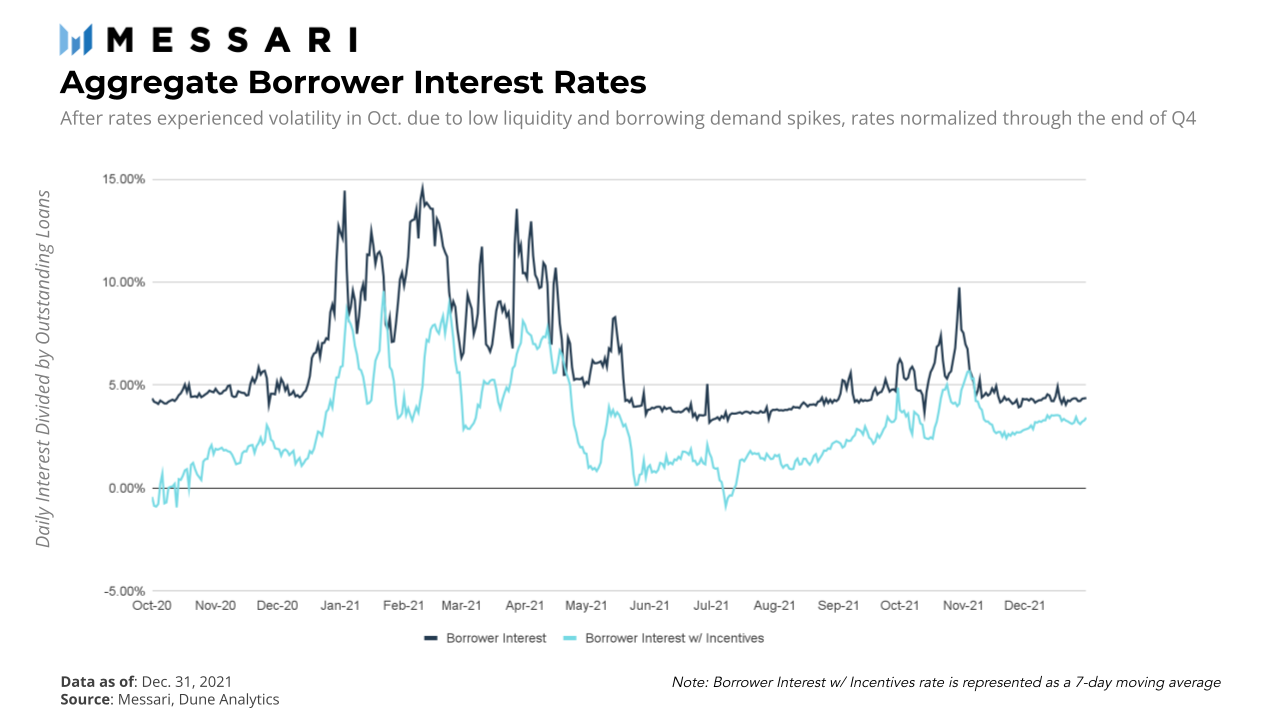
Borrower interest rates saw upwards volatility in October, with interest rates normalizing shortly afterward through the end of the quarter at slightly higher levels than otherwise seen in Q3. The average annualized borrowing rate for the quarter saw a moderate increase from 4.1% in Q3 to 5.0% in Q4. October’s borrowing rate volatility was due to two primary factors acting in tandem. First was the relatively slow redeposits of stables following the rapid withdrawals during the COMP distribution bug leading to a low supply of the most borrowed assets. The second was the general market conditions reaching all-time highs driving significant demand for leverage. Both forces working together - one causing low supply and the other demand spikes - resulted in borrowing rate volatility.
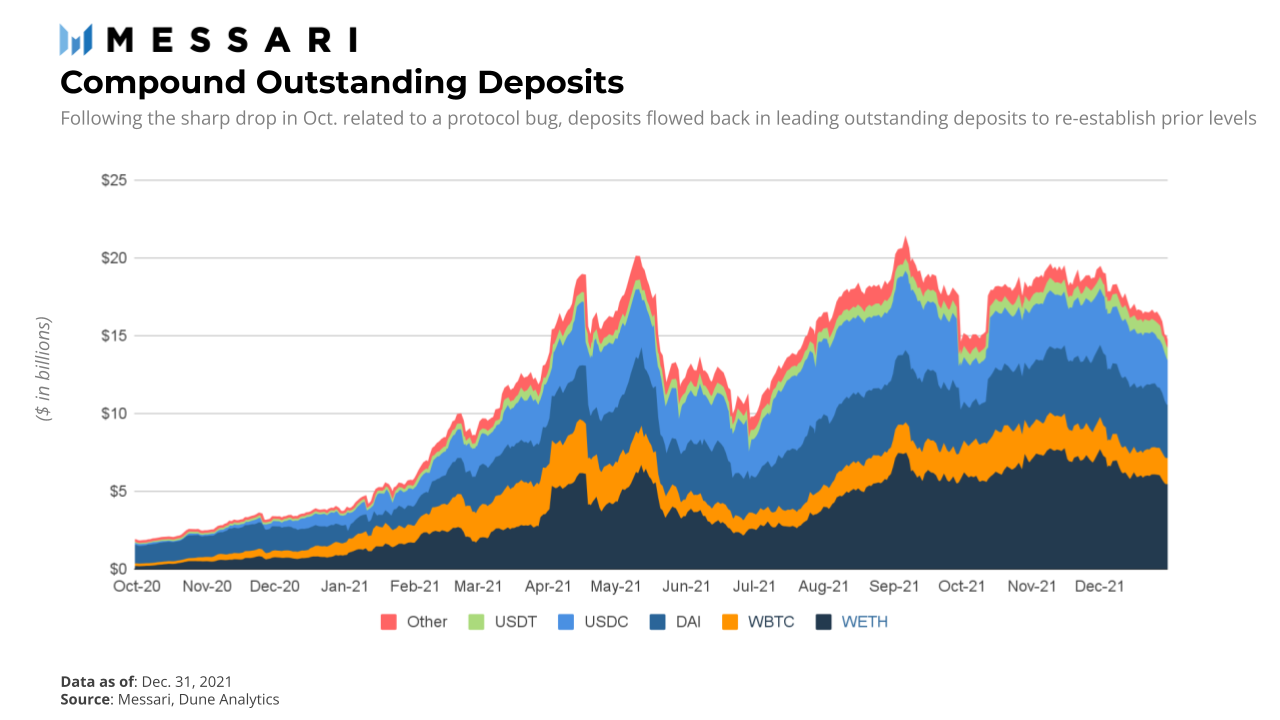
Similar to outstanding loans, by the end of the quarter, outstanding deposits had fallen 26% from the quarterly highs established, resulting in a relatively flat quarterly growth rate of 0.2%. With rising asset prices factored out, growth rates would have turned negative for Q4. WETH remained the largest deposited asset on Compound while DAI contributed the most to outstanding deposit growth as Coinbase’s new ‘DeFi Yield’ product opened a new influx of DAI through December to counteract the general withdraws occurring across Compound markets during the month. DAI is now the second most deposited asset in Compound and the most borrowed asset.
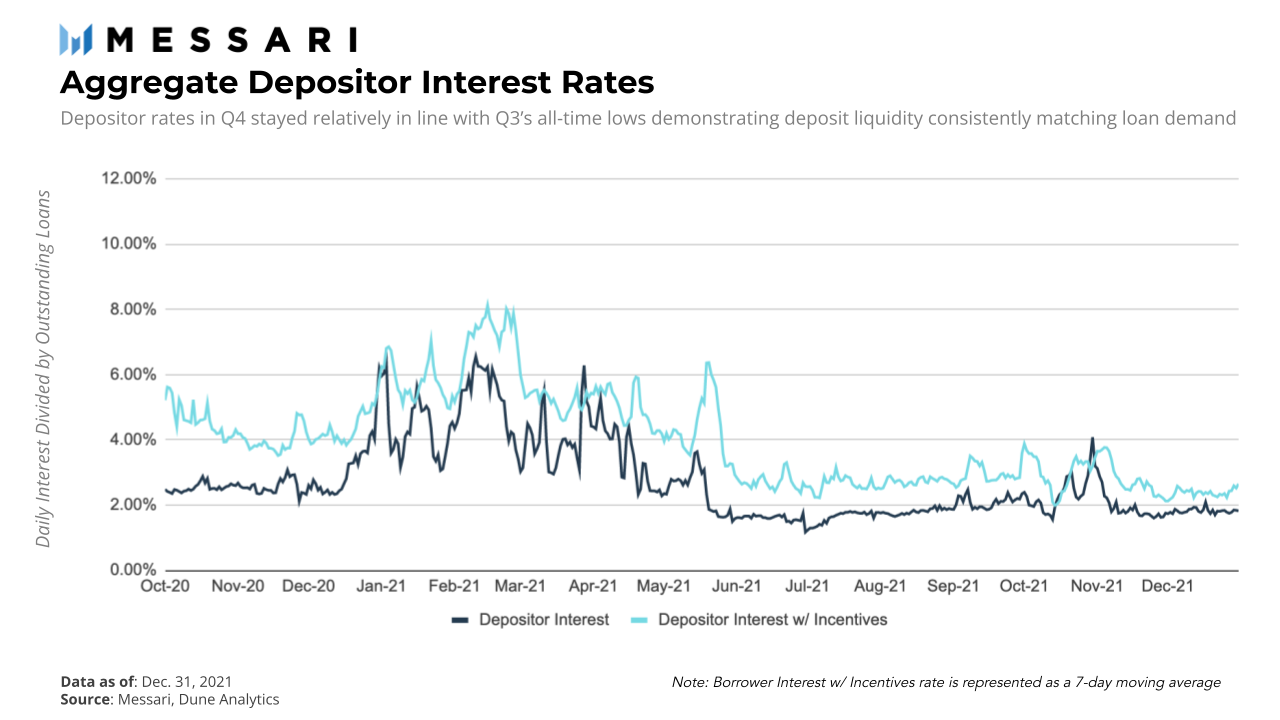
Outside of rate fluctuations during the COMP Distribution withdrawal period, depositor interest rates during the quarter stayed relatively in line with Q3’s all-time-low interest rates. Rates slightly increased over the quarter with the average annualized depositor rate increasing from 1.8% to 2.0%. Rate stabilization at these levels is indicative of product maturity as Compound liquidity consistently matched borrowing demand.
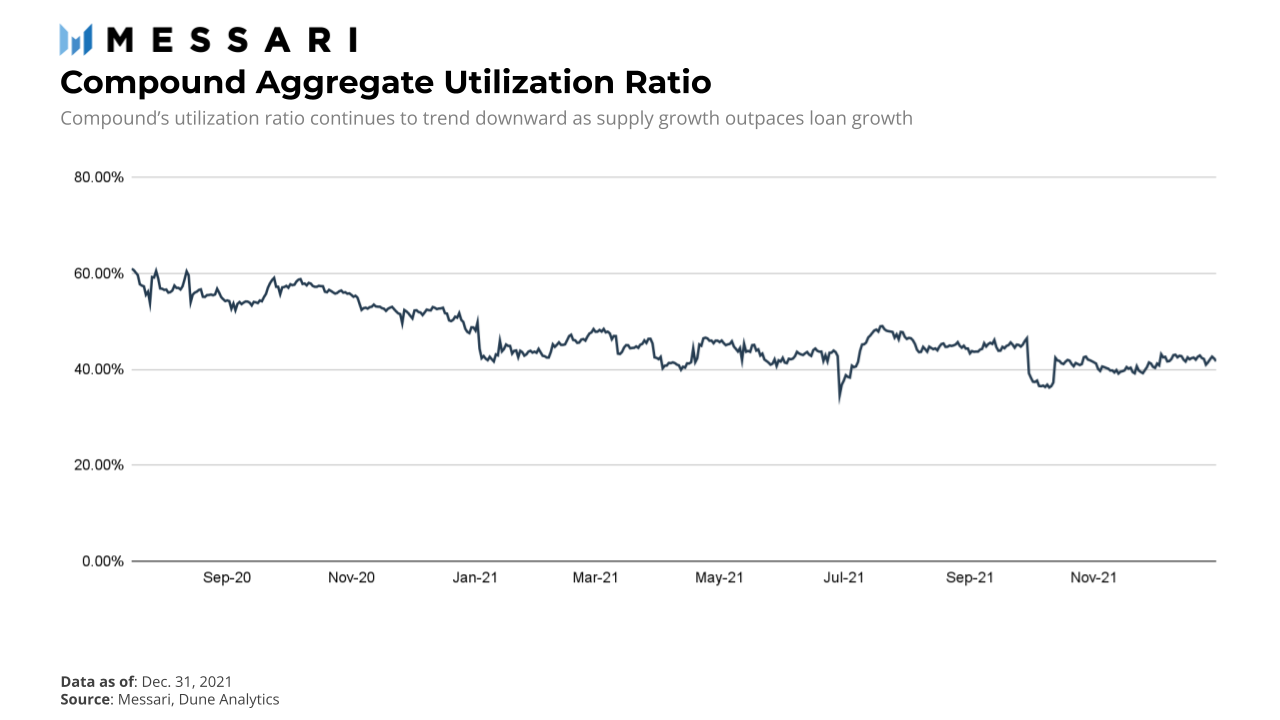
Compound’s aggregate utilization ratio continued to trend downwards, starting at the beginning of 2021, which best highlights the trend of depositor growth continuing to outpace loan growth. Additional sources of on-chain leverage coming online mid-2021 and rapidly maturing stablecoin liquidity continue to ease down Compound utilization rates as supply meets demand.
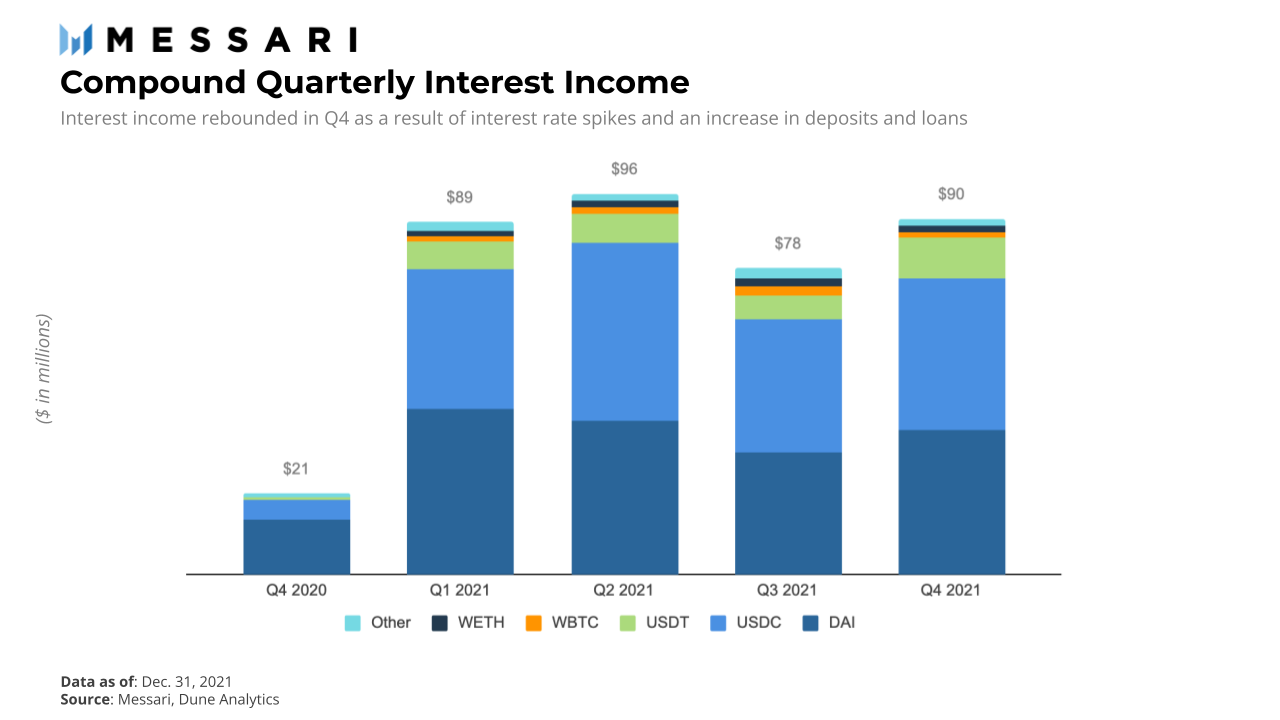
Quarterly interest income rebounded in Q4, increasing 16% from $78 million to $90 million, as the combination of interest rate spikes and sustained periods of high deposits and borrowing drove additional income compared to Q3’s largely risk-off environment. DAI and USDC accounted for the greatest drivers of interest income due to their borrowing popularity, representing nearly 75% of all interest income generated in Compound markets for the quarter.
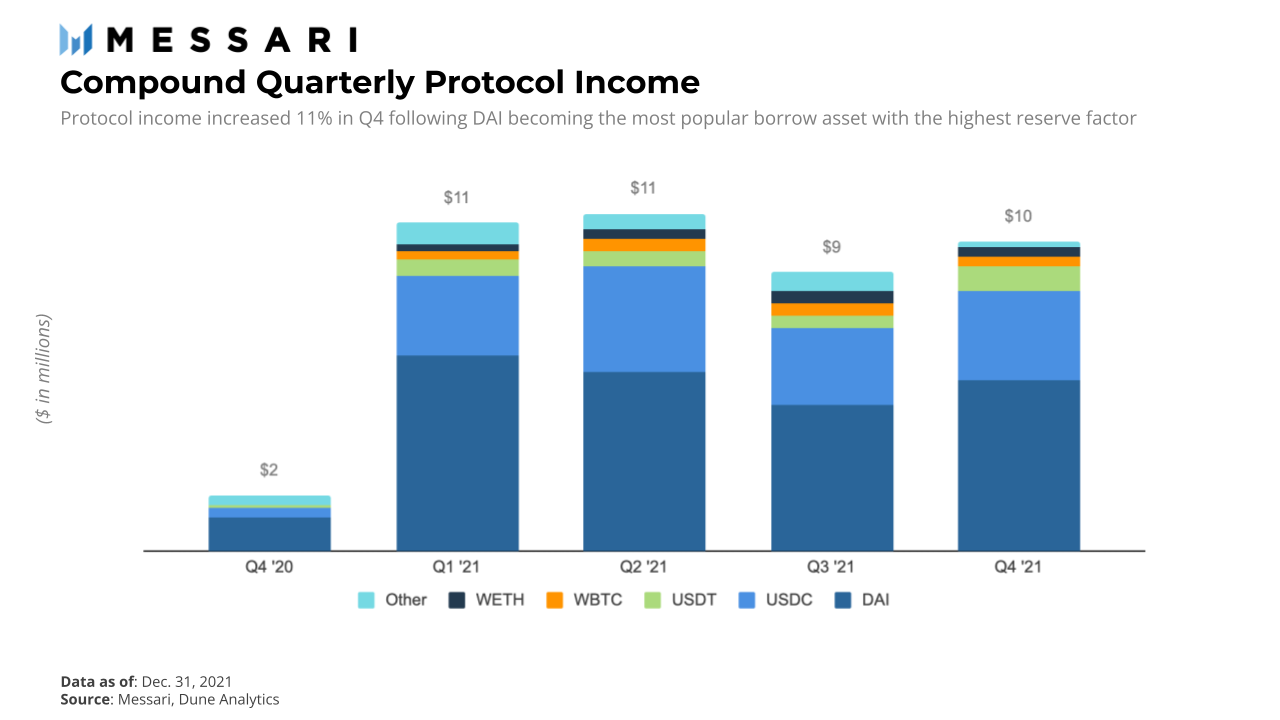
Compound generates protocol income by implementing a “reserve factor,” which is a percentage taken out of the interest paid by borrowers that can be used by governance for a variety of use-case or act as an insurance against borrower default. Reserve factors vary by asset, with DAI having the highest reserve factor of all stablecoins (the most borrowed asset on Compound) on the platform at 15%. For this reason, DAI has consistently been the most significant contributor to protocol income over the past five quarters, generating over 50% of protocol income in Q4. Protocol income increased 11% in Q4 rising from $9 million to $10 million, primarily attributed to DAI representing a larger share of the outstanding loans.
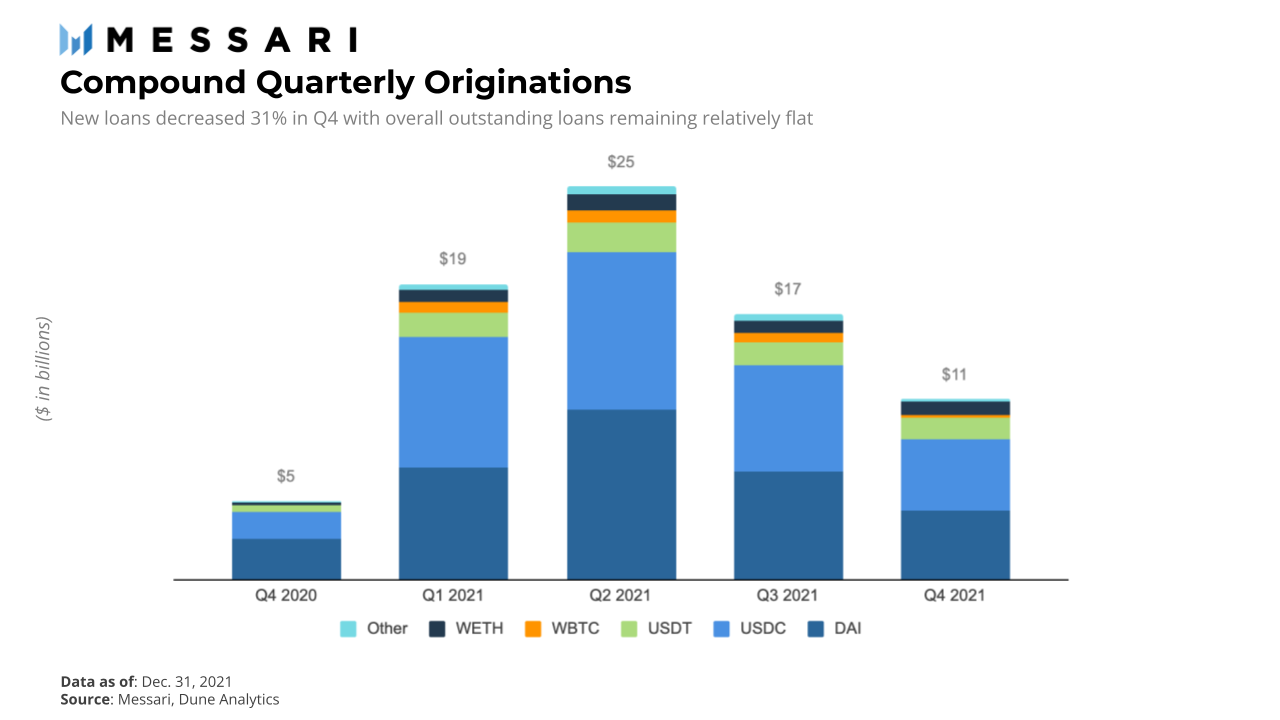
New loans (originations) continued to trend downwards significantly (-31% on the quarter) while overall outstanding loans remained relatively flat. Nearly 65% of the Q4 originations occurred in October when liquidity reestablished levels prior to the COMP distribution bug. Following this period, new loan demand dampened across the quarter ultimately leading towards regression in overall loan volumes in December.
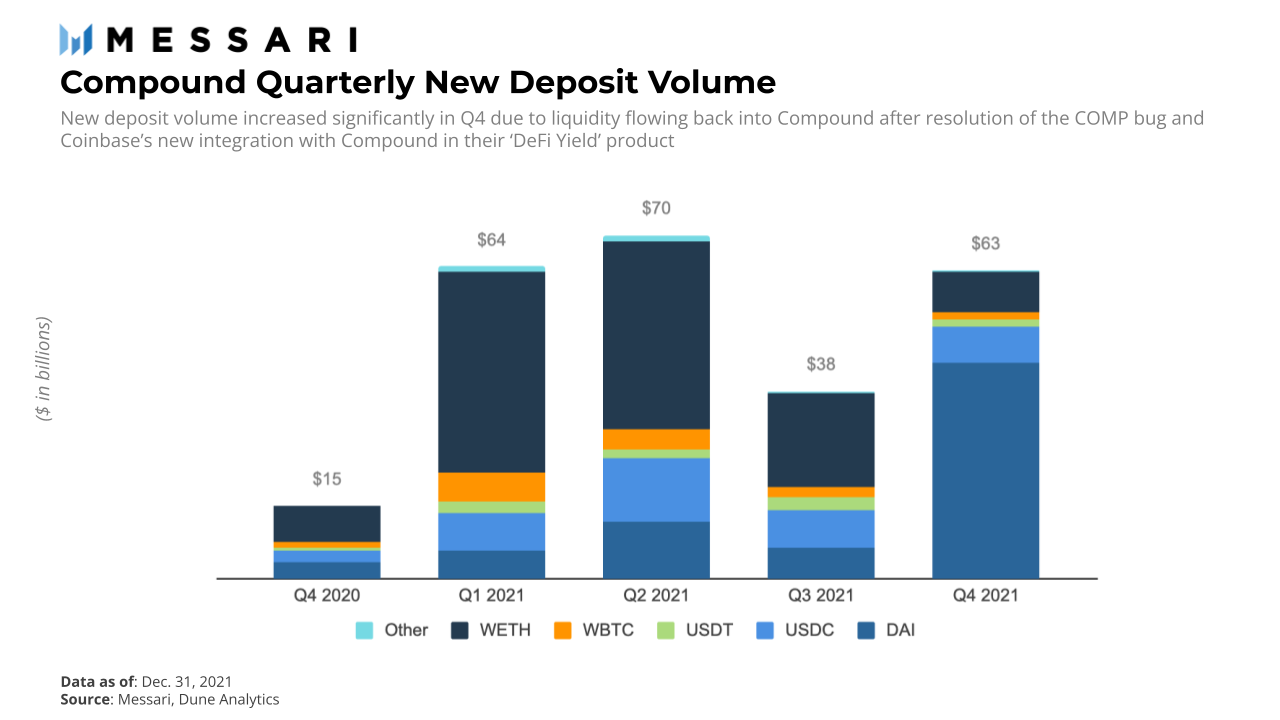
Deposit volume increased significantly in the quarter which can be attributed to both deposits flowing back into Compound markets after the COMP distribution bug resolution and the new Coinbase ‘DeFi Yield’ product. DAI made up 70% of the deposit volume in Q4 with 75% of the new DAI deposits occurring after the launch of the Coinbase integration in early December.
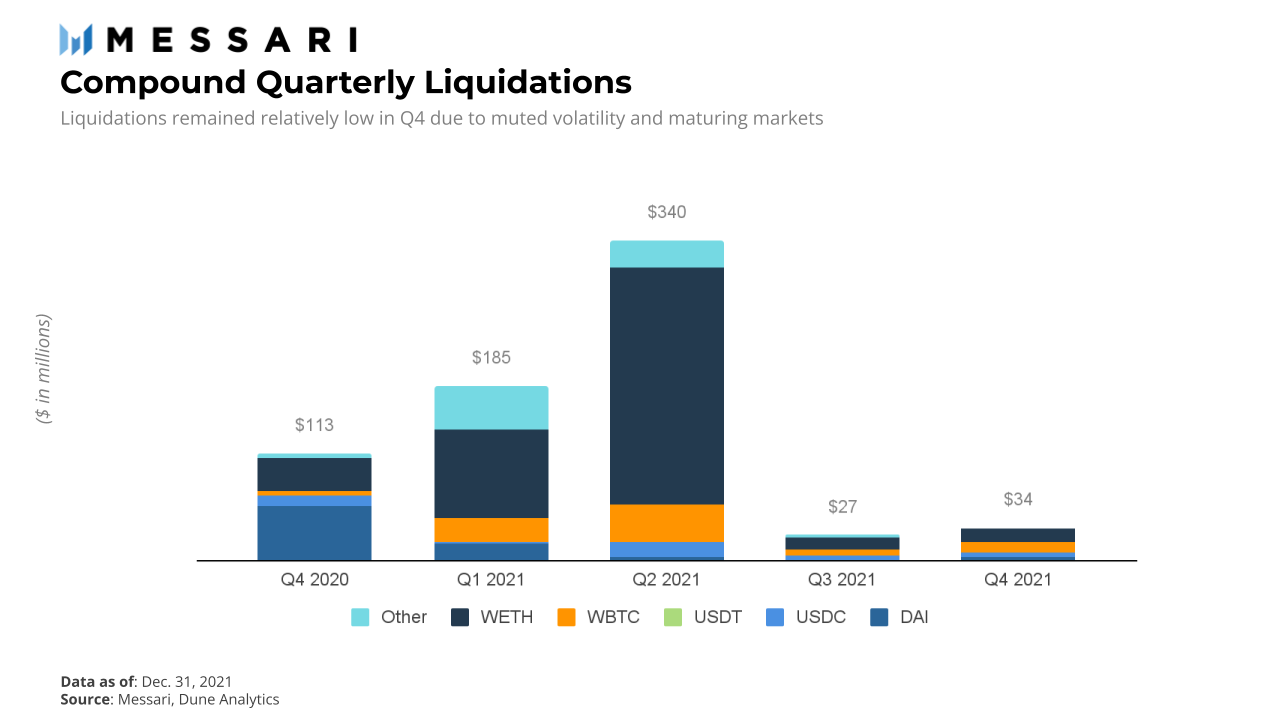
Liquidations increased 28% in Q4 from $27 million to $34 million, which is relatively low compared to previous quarters. Liquidations remain near the lowest levels seen in the past year due to relatively muted volatility and maturing markets.
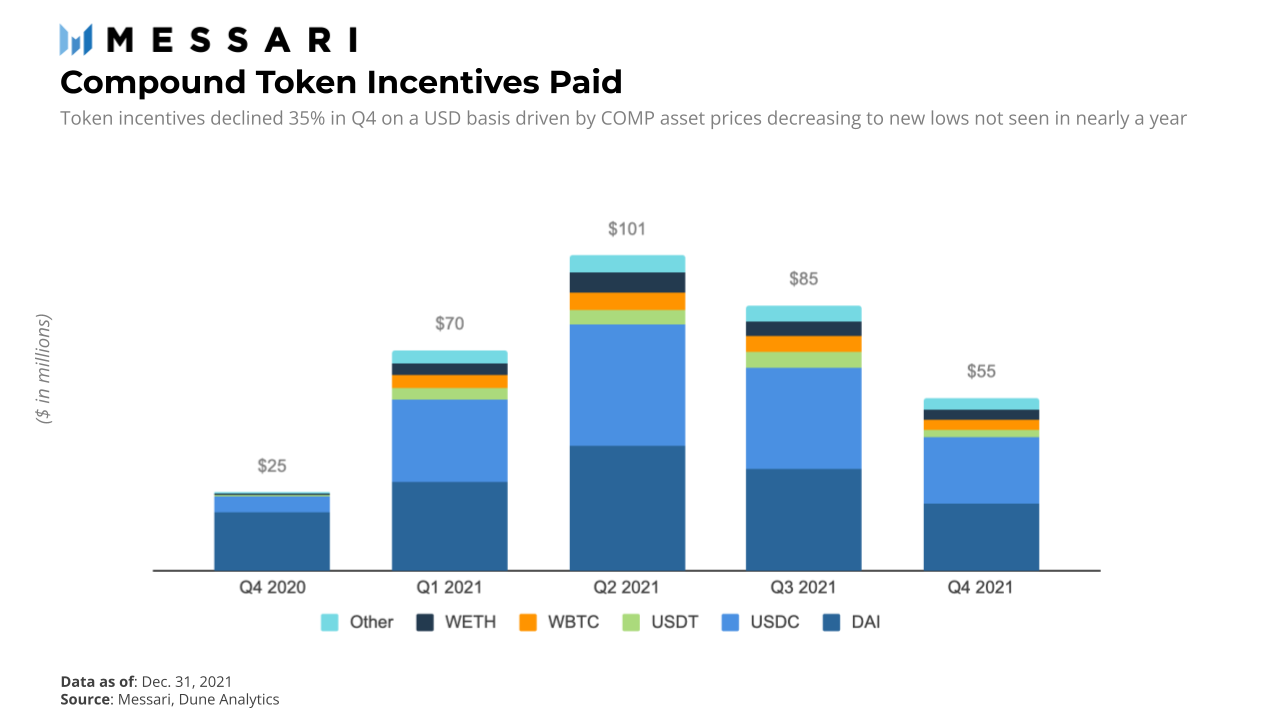
Lastly, one of the key drivers of all the activity in the Compound markets is the COMP token incentives for depositors and borrowers. Token incentives on a USD basis declined in Q4 by -35%, driven by COMP prices continuing to decline to a new low not seen in nearly a year. However, on a token basis, COMP rewards were only down -4.6%, primarily due to the COMP distribution bug remediations and pausing of COMP rewards for borrowing COMP.
Compound Markets - Micro Overview
Compound’s markets saw quite a few changes in Q4, including modifications to risk parameters across various assets, the addition of a Pax Dollar (USDP) market, and a flippening in the largest borrowing market compared to Q3. Stablecoins continue to be the most popular borrowing asset over more volatile assets, following the trend from previous quarters of stablecoins maintaining high utilization rates while the volatile assets remain in the single digits for utilization. The five largest Compound markets are further analyzed below.
DAI
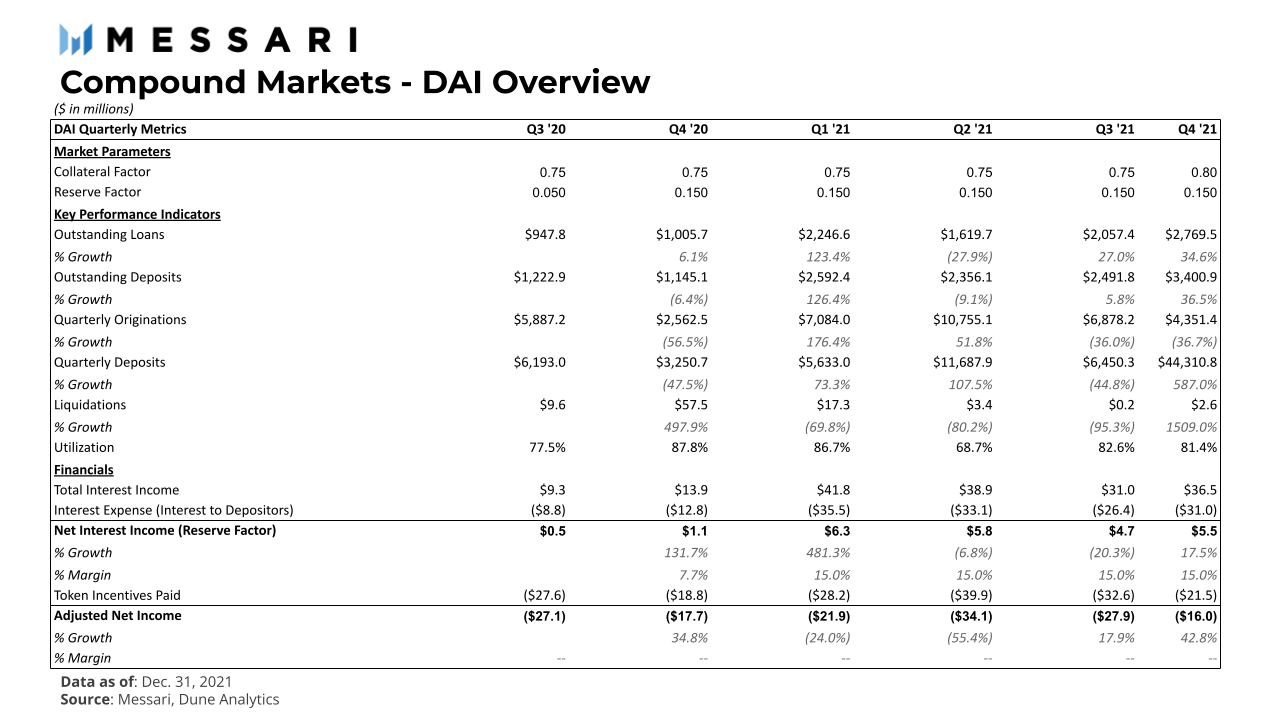
In Q4, DAI became Compound’s largest market by loans outstanding and was the single greatest driver to outstanding loan growth in the quarter, increasing 35% from $2 billion to $2.8 billion. DAI was also the most significant driver of outstanding deposit growth this quarter, increasing 37% from $2.5 billion to $3.4 billion, with deposit volume increasing 587% from $6.5 billion to $44 billion. This large increase in demand and outperformance compared to other markets can be attributed to Coinbase’s integration with the Compound protocol within their new DeFi Yield product, which allows users to earn a variable interest rate on DAI. The utilization rate decreased 1.2% by the end of the quarter, causing borrower interest rates to stay relatively flat, decreasing from 4.7% at the beginning of the quarter to 4.5% by the end of the quarter.
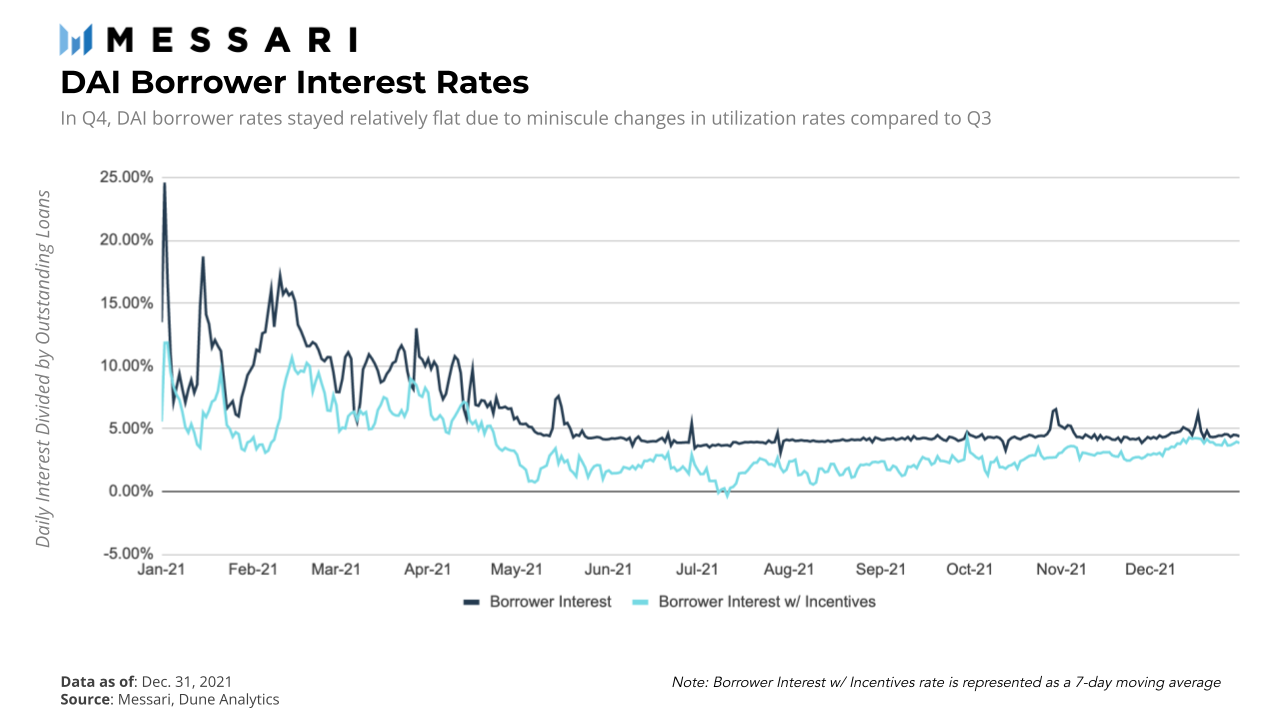
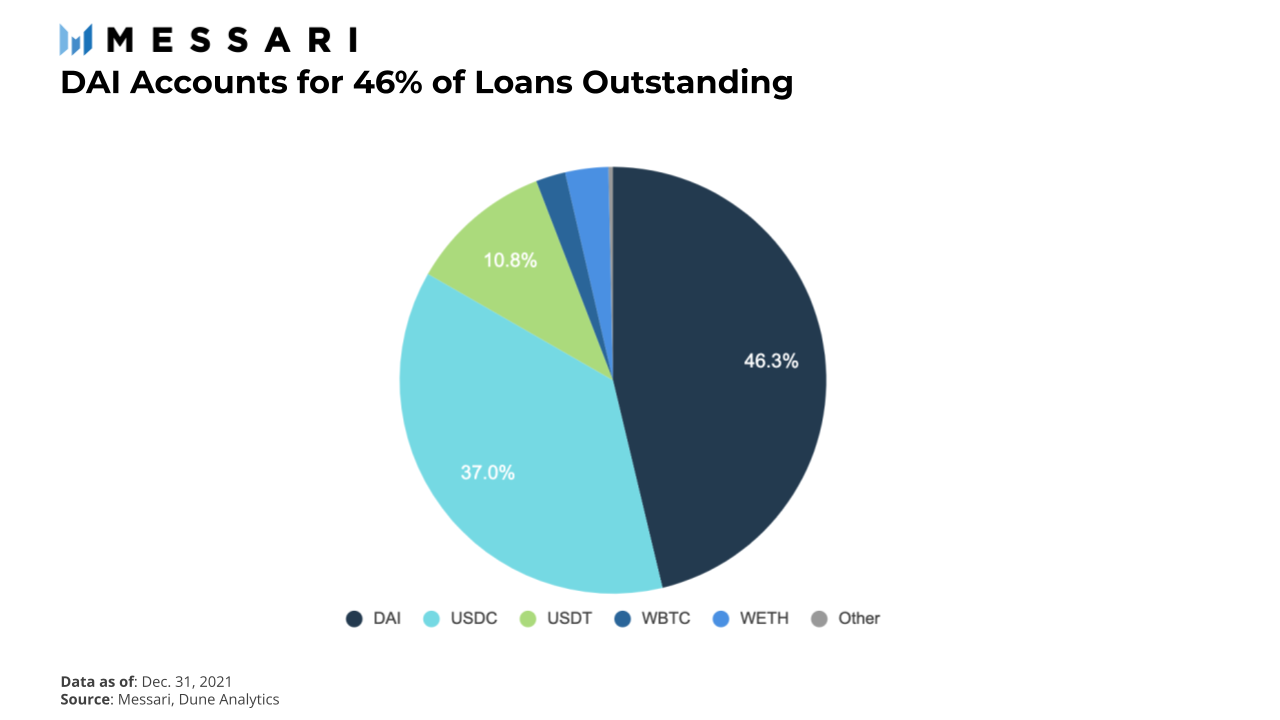
With the large inflow of DAI entering Compound’s markets, DAI ended the quarter replacing USDC as the most popular borrowing asset, representing 46% of all the outstanding loans.
USDC
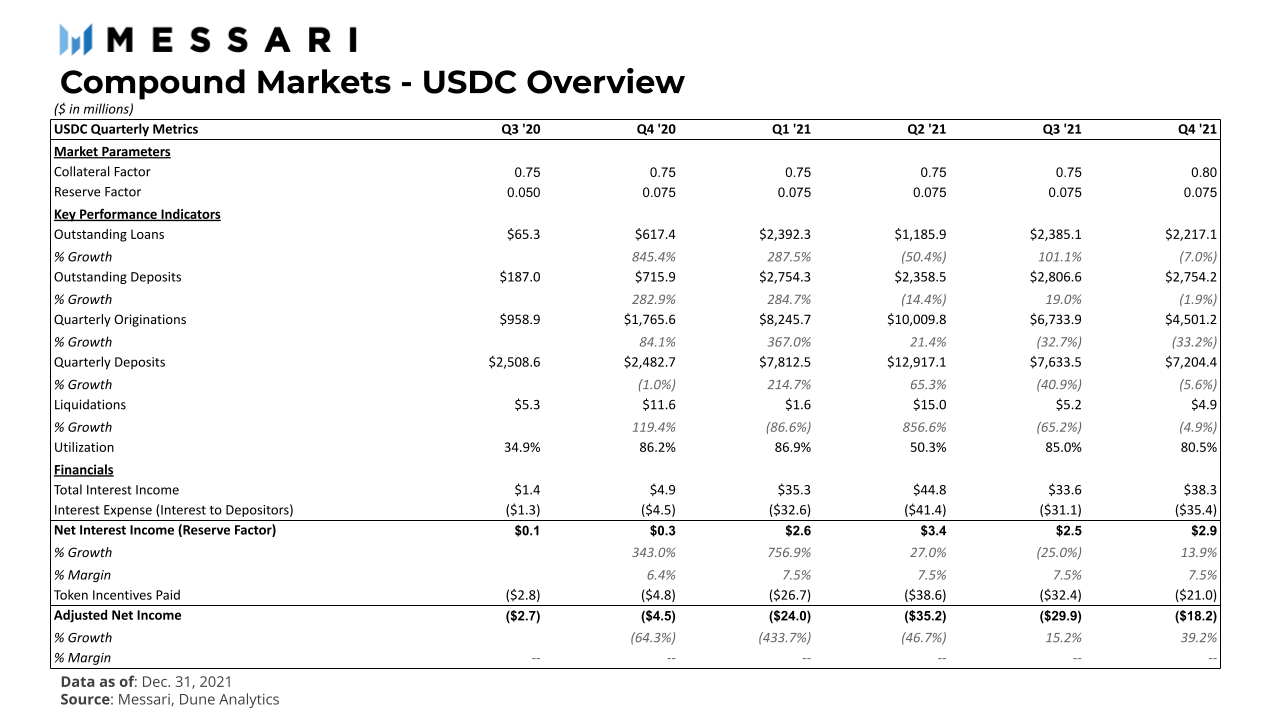
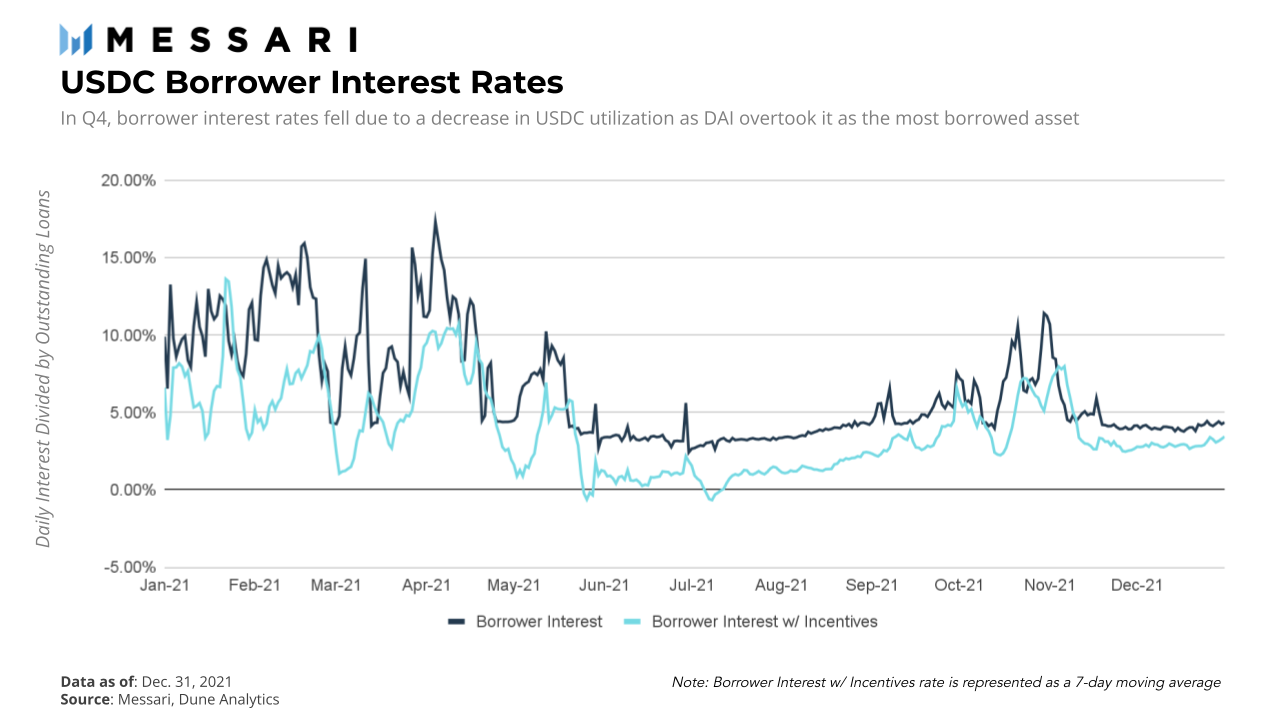
USDC saw a decrease of 7% in outstanding loans this quarter after being the largest driver to loan growth in Q3. Utilization rates decreased roughly 5% due to subsiding borrowing activity, which resulted in interest rates decreasing from 7.6% to 4.4% by the end of the quarter.
USDT
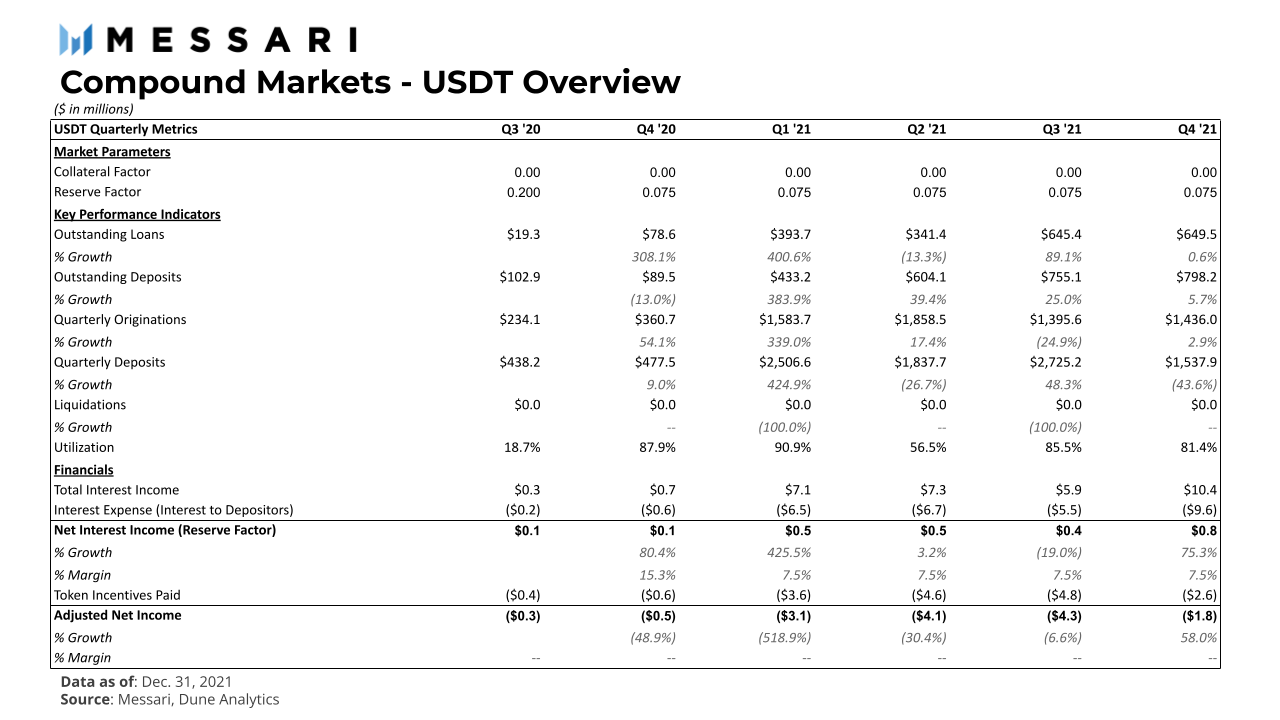
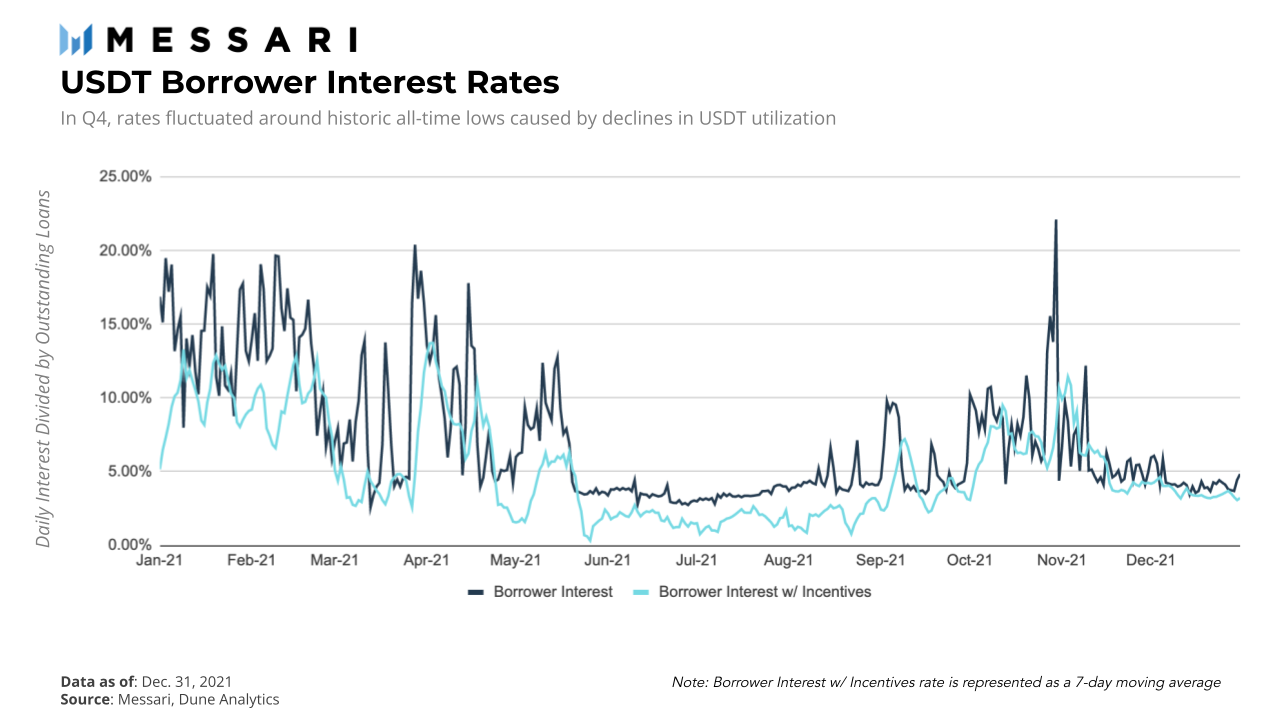
USDT was largely a similar story to USDC in Q4. Low growth of around 1% in outstanding loans coupled with a nearly 6% increase in overall deposits resulted in a 4% decline in utilization. USDT interest rates fell slightly from 5.6% to 4.8% at the end of the quarter as a result.
WBTC
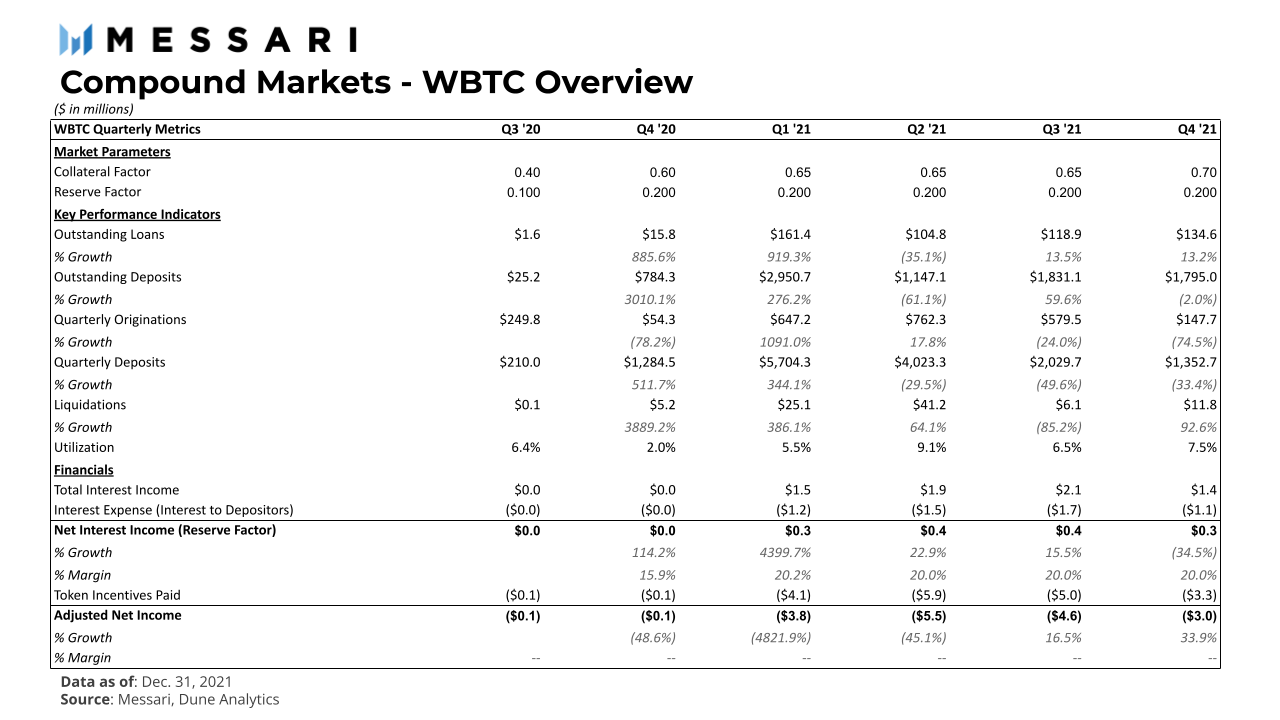
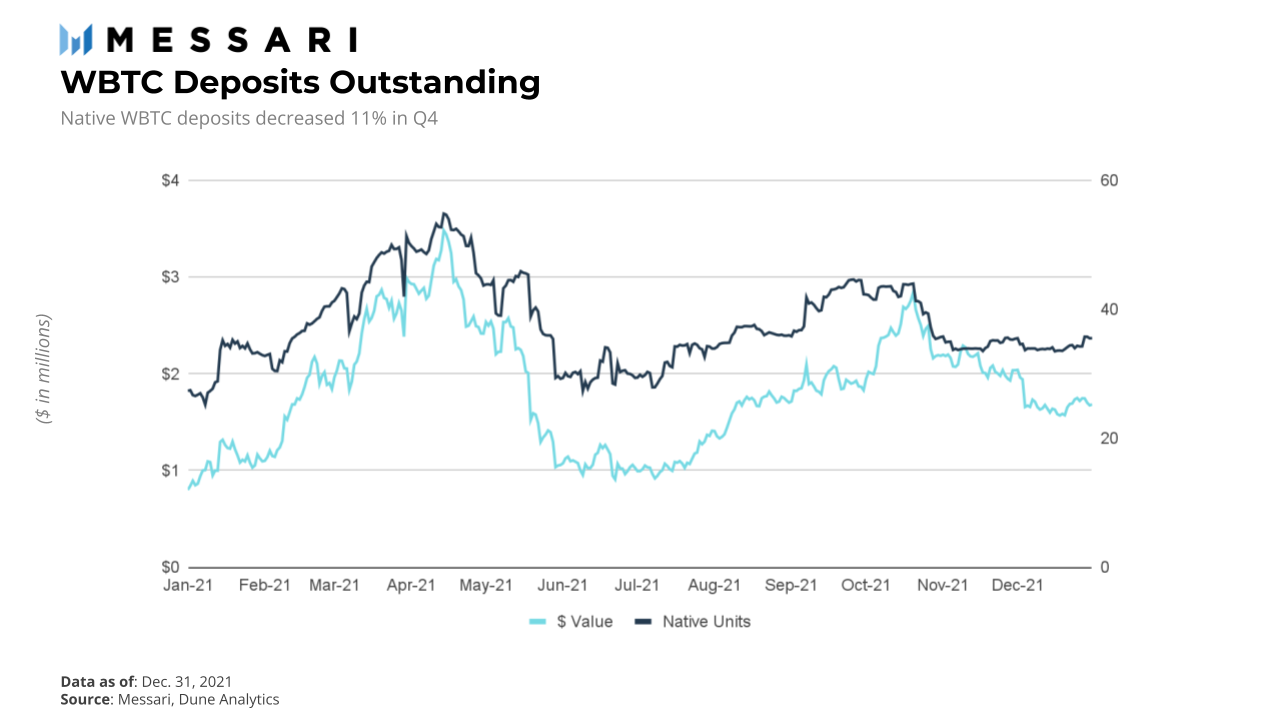
Outstanding loans for WBTC increased 13%, ringing in an all-time quarterly high of $135 billion. Outstanding deposits slightly decreased 2% in the quarter despite BTC’s price rising from $43,825 to $47,121. This increase in price artificially supported the outstanding deposit metric, which would’ve decreased 12% from Q3 to Q4 if BTC’s price would have stayed constant. After the BTC price peaked in late October, WBTC deposits remained relatively flat throughout the end of the year.
WETH
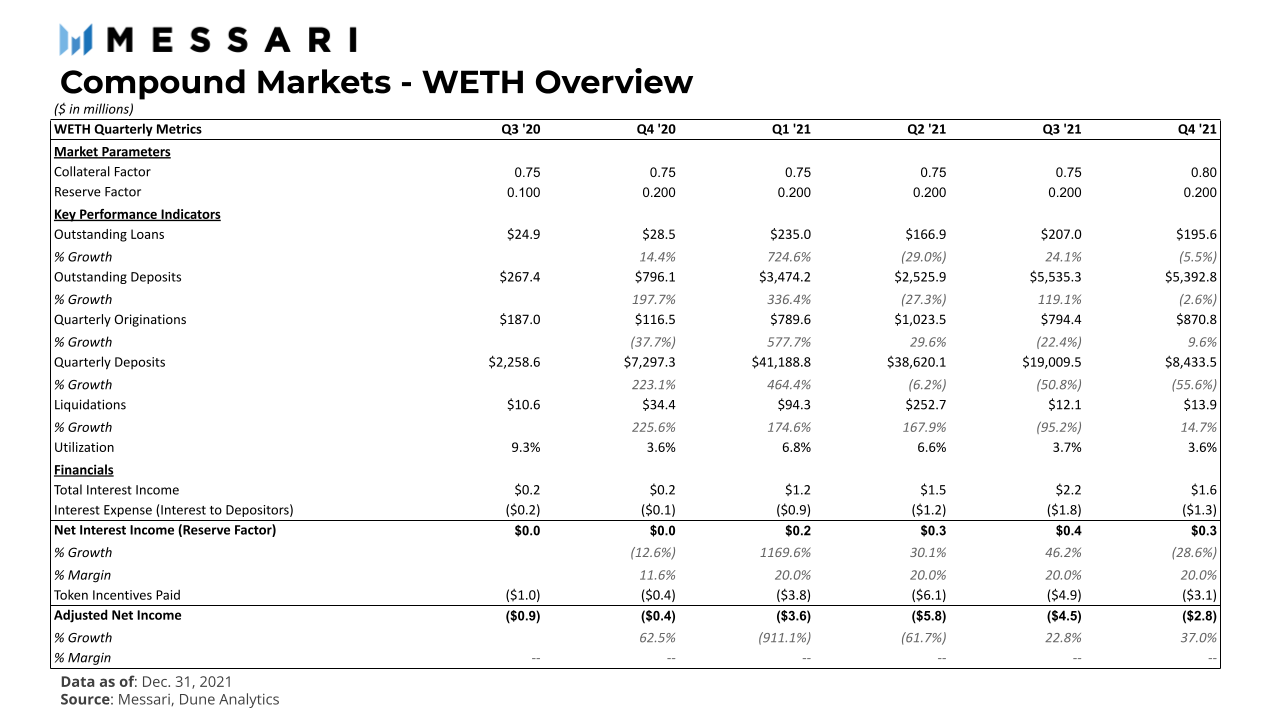
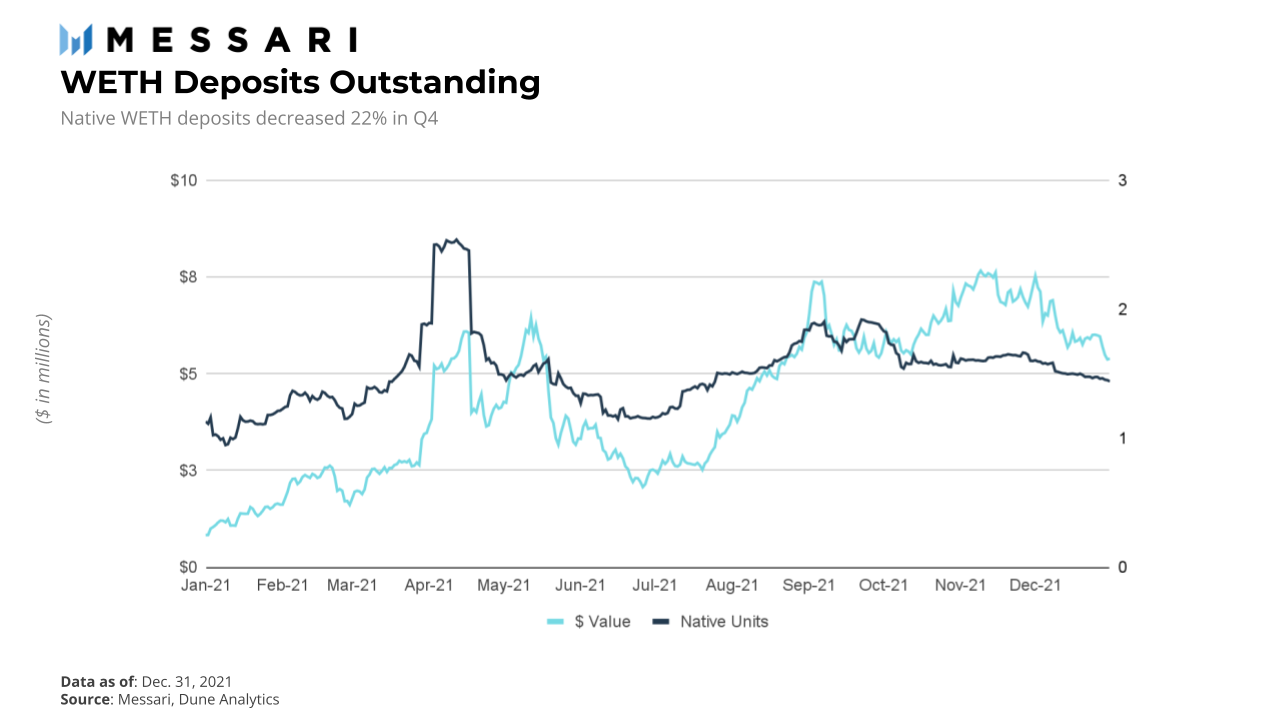
WETH is Compound’s largest market by deposits outstanding but had a slightly negative quarter decreasing 3% from $5.5 billion to $5.4 billion. ETH’s price increased from $2,938 in Q3 to $3,739 in Q4, a 27% increase. Without ETH’s price appreciation, deposits outstanding in Q4 would have been down 28%.
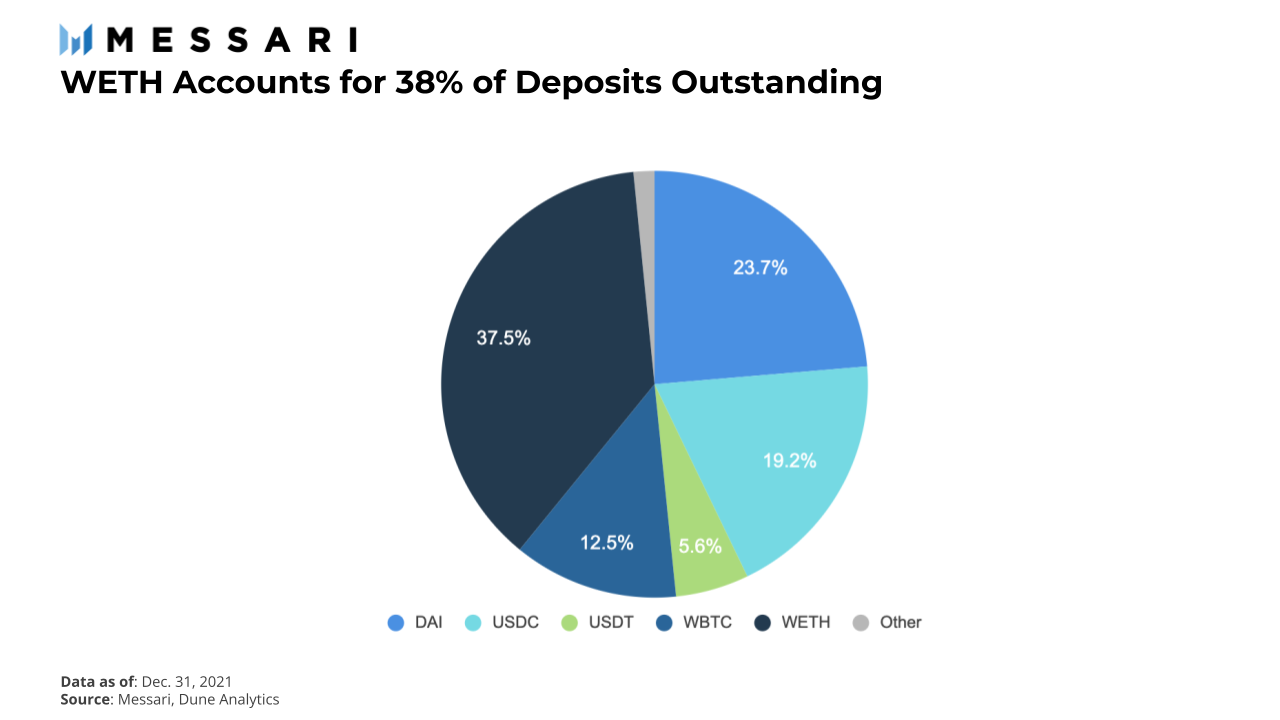
WETH represents 38% of Compound’s deposits outstanding, with DAI now being the second largest at 24%, surpassing USDC.
Governance & Key Events:
Key Events
Coinbase Integration
In early December, Coinbase announced its users in 70+ countries (excluding the US) would have access to Coinbase’s first DeFi protocol integration product, ‘DeFi Yield’. With ‘DeFi Yield’ users are able to earn a variable yield on DAI through the Compound Protocol. Coinbase offers the product without gas cost, fees, or lockups. As a result, the average daily DAI deposits tripled following the announcement. Average daily DAI deposits in the quarter prior to the announcement were $0.16B while after the product release on December 9th, $1.4B DAI on average was deposited into Compound.
COMP Bug + Audits
Executed just prior to Q3 close,Proposal 062 implemented a bifurcation of COMP rewards between deposits and borrows while also unintentionally introducing a bug that exposed certain markets to excess COMP rewards should users choose to claim the erroneously accrued COMP. As a result, ~200k COMP ($68M) was sent to the Compound Controller and misallocated.
Shortly after the bug’s discovery,Proposal 064 was passed and executed to patch the bug.Proposal 065 quickly followed in mid-October, which implemented a mechanism to recover over-accrued COMP and reestablished COMP rewards across the protocol.
To safeguard against future security concerns like the accrual bug, the Compound community invited proposals from a variety of firms to perform ongoing security reviews. In mid-December,Proposal 076 approved engagement with OpenZeppelin for continuous audit and security solutions.
MakerDAO Deposit Module
In early December, GFX Labs and the Compound community proposed to MakerDAO to prioritize a Compound DAI Direct Deposit Module (D3M). D3M is a Maker Protocol implementation that enables Maker to directly inject DAI into the Compound DAI borrowing market. Currently, Aave is the only protocol to which D3M has been implemented. Voting passed on the MakerDAO poll in January 2022.
Governance Decisions
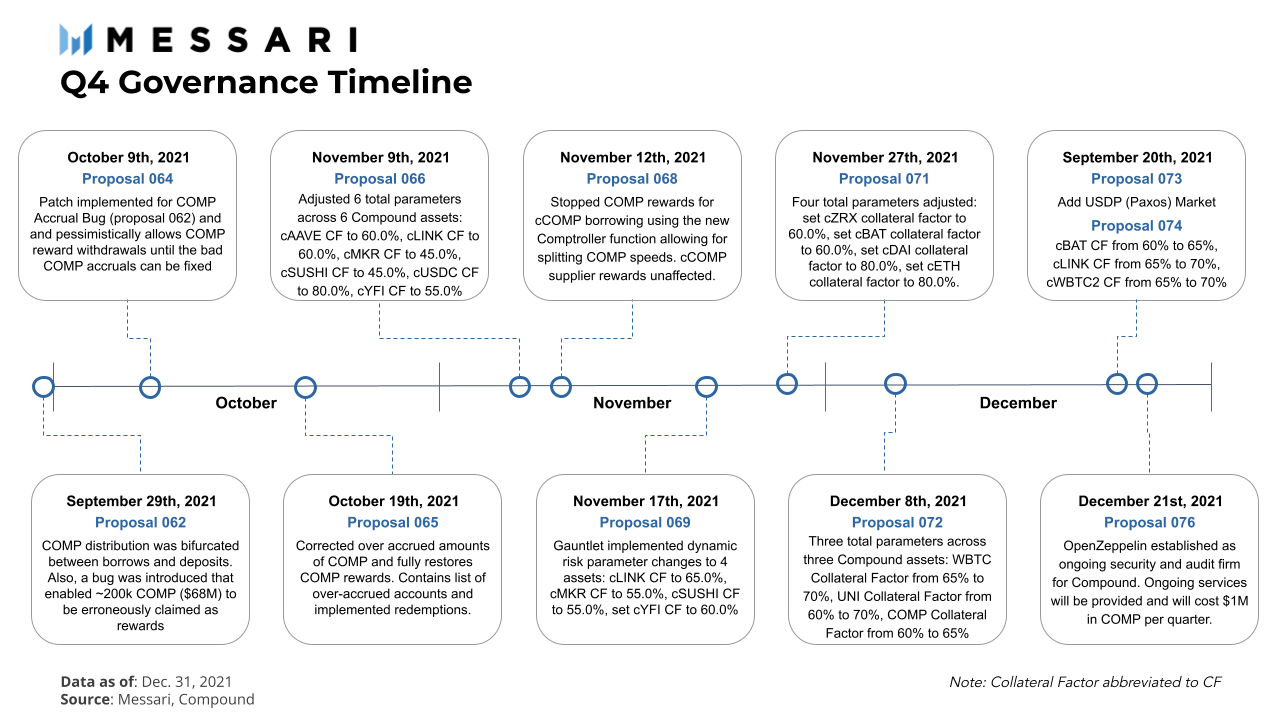
Proposal 076 - OpenZeppelin Continuous Protocol Audit - December 21st, 2021
OpenZeppelin would provide a dedicated continuous audit services for all Compound governance proposals and will work with the Compound community to develop security requirements and to implement best practice security monitoring.
OpenZeppelin has revised its original proposal to exclude performance fees. OpenZeppelin’s fee will be the equivalent of $1 million USD in COMP every quarter for one year, to provide these services. This fee covers all services defined in the proposal.
OpenZeppelin’s proposal was considered by the community alongside Trails of Bits and ChainSecurity proposals. OpenZeppelin ended up winning the bid to provide continuous audit and security services to Compound.
Proposal 074 - Risk Parameter Updates for WBTC, BAT, and LINK - December 20th, 2021
Proposal 074 aimed to adjust three total parameters across three Compound assets. It changed the WBTC, BAT, and LINK markets as follows: cBAT Collateral Factor from 60% to 65%, cLINK Collateral Factor from 65% to 70%, cWBTC2 Collateral Factor from 65% to 70%.
Proposal 073 - Add PAX Dollar (USDP) - December 20th, 2021
Paxos Standard was added as a stablecoin on Compound with the proposed risk parameters: collateral factor 0-25%, reserve factor 20-30%, no COMP speed, borrow cap 80%.
Proposal 072 - Risk Parameter Updates for WBTC, UNI, and COMP - December 8th, 2021
Proposal 072 adjusted three total parameters across three Compound assets. It changed the WBTC, UNI, and COMP markets as follows: WBTC Collateral Factor from 65% to 70%, UNI Collateral Factor from 60% to 70%, COMP Collateral Factor from 60% to 65%.
Proposal 071 - Risk Parameter Updates for DAI, BAT, ZRX, and ETH - November 27th, 2021
Proposal 071 adjusted four total parameters across four Compound assets to align with the moderate risk level chosen by the Compound community. It would: Set cZRX collateral factor to 60.0%, set cBAT collateral factor to 60.0%, set cDAI collateral factor to 80.0%, set cETH collateral factor to 80.0%.
Proposal 069 - Risk Parameter Updates for LINK, MKR, SUSHI, and YFI - November 17th, 2021
Proposal 069 adjusted 4 total parameters across 4 Compound assets. This proposal is a batch update of risk parameters to align with the Moderate risk level chosen by the Compound community. These parameter updates are the second of Gauntlet's regular parameter recommendations as part of Dynamic Risk Parameters: set cLINK collateral factor to 65.0%, set cMKR collateral factor to 55.0%, set cSUSHI collateral factor to 55.0%, set cYFI collateral factor to 60.0%.
Proposal 068 - End cCOMP Borrow Rewards - November 12th, 2021
Proposal 068 stopped COMP rewards for cCOMP borrowing using the new Comptroller function allowing for splitting COMP speeds. COMP rewards will remain the same for cCOMP suppliers.
Proposal 066 - Risk Parameter Updates for AAVE, LINK, MKR, SUSHI, USDC, and YFI - November 9th, 2021
Proposal 066 adjusted 6 total parameters across 6 Compound assets. The adjustments were as follows: set cAAVE collateral factor to 60.0%, set cLINK collateral factor to 60.0%, set cMKR collateral factor to 45.0%, set cSUSHI collateral factor to 45.0%, set cUSDC collateral factor to 80.0%, set cYFI collateral factor to 55.0%.
Proposal 065 - Correct Over-Accrued COMP - October 19th, 2021
This proposal corrects the amounts of over-accrued COMP due to the bug in Proposal 62 (September 29th) and fully restores the functionality of COMP rewards. It contains an exact list of users who have over-accrued COMP along with the exact amounts they over-accrued and calls a newly introduced one-off function, fixBadAccruals, to correct the over-accrued COMP.
Proposal 064 - Fix COMP Accrual Bug - October 9th, 2021
Proposal 064 patched the bug introduced in Proposal 62 and pessimistically allow COMP reward withdrawals until the bad COMP accruals can be fixed.
This new proposal also corrected proposal 63 which prevents further COMP from being distributed until the correct logic is restored but causes issues for protocols that integrated with Compound and required the claim functionality.
Governance Discussions
COMP Distribution Speeds
After analyzing Compound and its markets’ compSpeed, GFX Labs proposed reducing compSpeed across markets. CompSpeed is essentially the amount of COMP distributed to suppliers and borrowers and acts as a liquidity incentive. GFX Lab’s core premise is that the roughly $160M spent annually in compSpeeds is overpaying for liquidity when sufficient liquidity already exists (new markets added being the exception).
Discussion centers around either reducing compSpeed to zero, gradually reducing the compSpeed, or doing nothing at all.
Grant Program Overview:
The Compound Grants Program (CGP) 1.0 was an enormously successful experiment that ran from March 2021 to September 2021 with the simple idea of funding contributors to improve Compound. The program funded over 30 grantees with over $1 million in funding which went towards open-source dashboards, analytics, hackathons and much more.
With the conclusion of the first iteration of the grants program, a pause has been put on all new grants leading to zero grants being distributed in Q4. With the success of the initial grant pilot program, the grant committee members are preparing to double-down and create a grant program that is superior to GCP 1.0 in grant size, speed, and structure. GCP 2.0 is currently being built with no launch date announced yet.
Roadmap
Near-term objectives for Compound are to continue to add new markets and refine risk parameters, especially with the newly added OpenZeppelin continuous audit, which removes the burden of security from the community.
Further out objectives are largely centered around two main efforts from Compound Labs: Treasury and Gateway. Treasury is Compound’s B2B offering which aims to offer Compound yields to traditional firms. Gateway is the larger undertaking that is poised to holistically re-architect Compound to efficiently meet global scale demands.
Gateway
In March of 2021, Compound Labs announced a prototype based on a whitepaper for Compound Chain, an independent blockchain that would serve as infrastructure for cross-chain interest rate markets, known as Gateway. Gateway intended to be a Substrate-based blockchain that would facilitate borrowing and lending of native assets across various external blockchains. The goal was to introduce a new stablecoin, CASH, to be Gateway’s native unit created through borrowing, much like MakerDAO’s DAI, where all interest would be earned and paid in CASH.
This cross-chain interoperability was an ambitious and challenging undertaking with the potential to revolutionize the cross-chain lending and borrowing industry. Since the announcement of the Gateway project last year, the Compound Labs team had released multiple versions of a Gateway prototype, numerous other teams started experimenting with multi-chain approaches, and several cross-chain protocols lost assets to security incidents.
Due to those events in the past year and the incredible speed at which the crypto ecosystem has been developing, the Compound Labs team decided to adapt and proposed an alternate approach to what they believe is the correct multi-chain strategy. The team decided that it was prudent to initially focus on launching Compound on EVM-compatible chains as fragmented markets rather than launch Gateway connected to starports on external chains. This alternate approach eliminates the risk and complexity involved with a shared liquidity pool, which the community can eventually decide to upgrade to in the future.
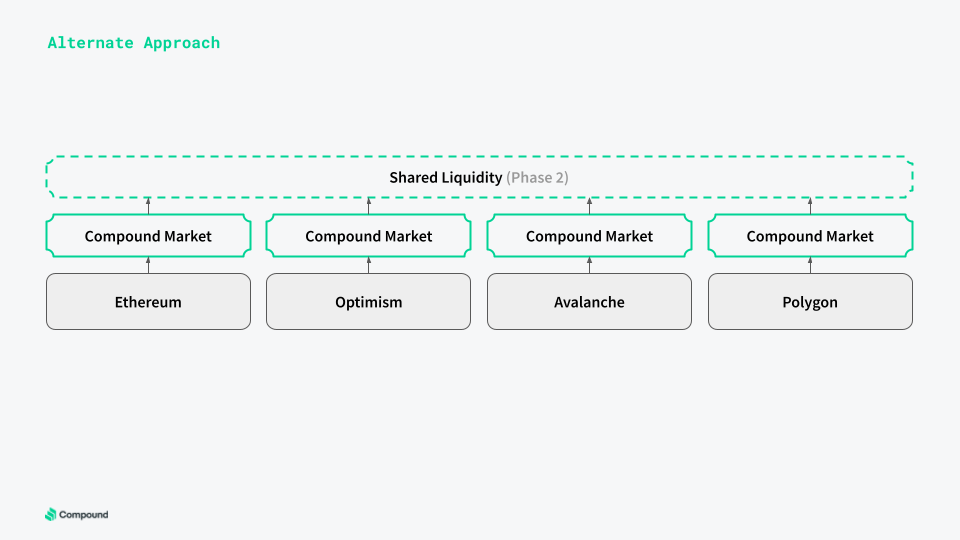
In Compound’s markets, stablecoins continue to be the most popular asset to borrow while more volatile assets are more popular as collateral. From this observation, one of the biggest design changes Compound Labs is proposing for their multi-chain approach is to only allow a single borrowable asset with an N number of collateral assets. This would create only one asset with an interest rate model, which would improve protocol risk and reduce the code base.
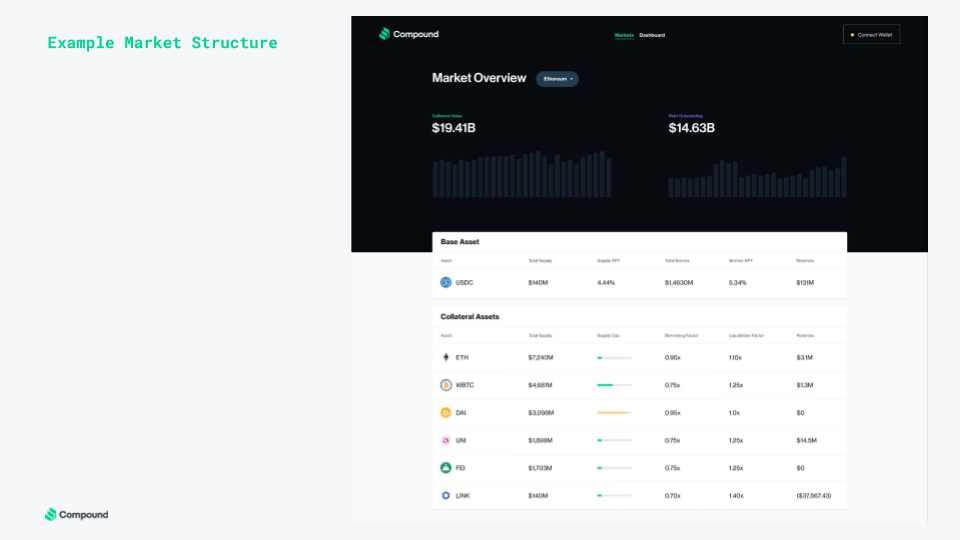
The next steps Compound Labs have outlined are to complete the initial code-base, begin security audits, deploy to test nets, and eventually launch the protocol on Ethereum when the community decides. From there, the community will have the ability to deploy the protocol on any external blockchain.
Closing Thoughts:
Being a financial services business, Compound will always be influenced to an extent by the broader market and macro environment. Q4 started with a strong recovery in outstanding loans and deposits as capital flowed back into Compound markets after the COMP distribution bug caused a liquidity contraction at the end of Q3. Capital remained at those elevated levels throughout the quarter until the broader market began selling off towards the end of the year, driving Compound’s metrics down with it. Overall, Compound’s quarter-ending figures sit at all-time highs in key metrics like outstanding loans and deposits, as well as strong growth in net protocol income.
With Compound being one of the first protocols that has moved towards distributed governance and distributed development, incidents such as Proposal 062’s COMP distribution bug are a reflection of the organization model’s experimental nature. The Compound community has used this incident as a catalyst for change, where more participants will be involved with the governance and development process, leading to more thorough analysis and reviews on proposals going forward. The community has come out of Q4 stronger and with more lessons and tools under its belt. With the community focused on new protocol updates, exchange and protocol integration, and institutional adoption of DeFi, the future of the Compound protocol continues to shine bright.

Dustin was previously the Enterprise research director at Messari. He has a broad focus across crypto with a particular interest in AI x Crypto, Consumer financialization, DeFi, and general infrastructure.

Sami Kassab is an Enterprise Research Analyst focusing primarily on Web3 Infrastructure and Bitcoin. Sami previously spent 5 years as an Aerospace Engineer designing aircraft engines and missile & defense systems.