Staking as a catalyst: Cardano's recent rise is part of a larger trend

DeFi has become crypto's latest trend, but Cardano’s recent run is proof that staking isn’t dead. The once king of the Ethereum Killers has surged over 270% in the last three months, outpacing BTC and ETH by a significant margin.
It’s a welcomed sight for Cardano diehards who watched ADA freefall over 95% from its Jan. 2018 all-time high. Like most cryptoassets launched in 2017, it rose to popularity well before the project had a product worth using. The first version of Cardano’s mainnet didn’t support much beyond token transfers on a federated blockchain. Its value prop hasn’t changed much since, as most project developments have focused on Cardano’s next iteration.
Now, that work is starting to see the light of day. IOHK, the core development team for Cardano, has deployed the code for Cardano’s second incarnation, Shelley, which should be activated via a hard fork by the end of July. This long-awaited release will launch Cardano’s proposed Ouroboros Genesis Proof-of-Stake (PoS) protocol, with staking rewards arriving shortly thereafter.
The events and announcements about Shelley have acted as catalysts for ADA’s recent price movements.
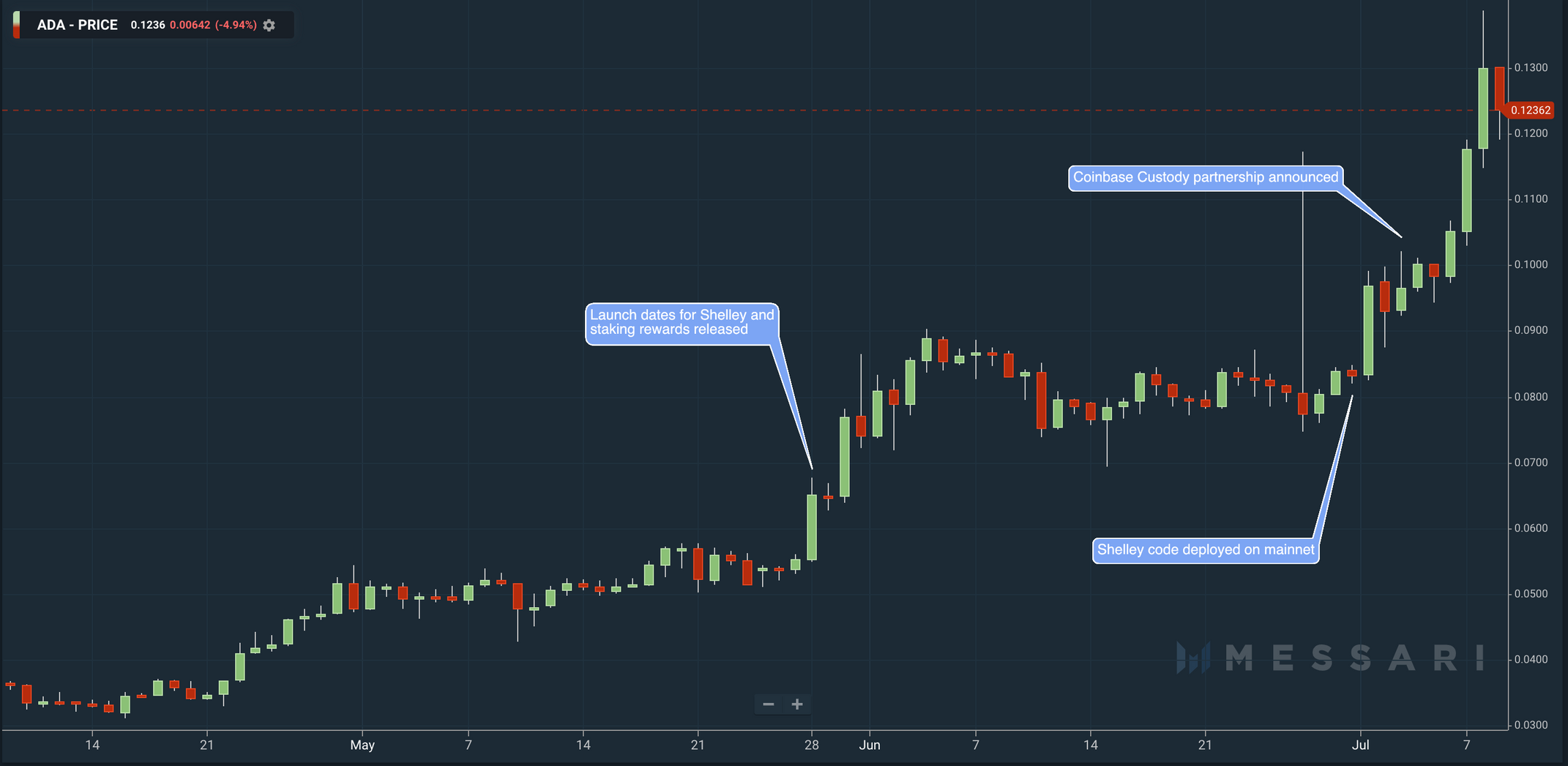
Click here for the full interactive chart
Prospective stakers scooping up ADA and those speculating on the allure of staking rewards have likely driven this upward trend. Both strategies seem logical. Staking is more lucrative early on since participants experience a diminishing return as more stakers join the network.

Wilson Withiam was a Senior Research Analyst at Messari. Previously, he worked at Circle Research where he conducted research on cryptoassets. He graduated with a B.Sc. in Kinesiology and Exercise Science before studying computer science and economics at UConn.