Open Finance Fundamentals: The prime brokers of tomorrow

This report is part of a weekly series where we will explore the mechanics behind major Open Finance protocols and evaluate them on a fundamental basis. You can view prior reports here.
If you are trading an asset that is listed on multiple venues, there will likely be differences in the price traded and order-book depth. Even if you choose the exchange with the best price, it may not have enough liquidity to satisfy your purchase which could lead to substantial slippage. For this reason, smart order routing was invented to enable purchasers to access the liquidity from multiple exchanges in order to minimize the costs of trading.
This function is typically performed by prime brokers such as Merril Lynch, or in cryptoland Tagomi. However, in the world of DeFi, adding a centralized entity to execute trades on your behalf damages the whole point of decentralization. To solve this need while retaining the spirit of DeFi, we have seen a handful of projects, aptly referred to as DEX aggregators, that look to aggregate liquidity across multiple decentralized exchanges. By using exchanges such as Uniswap, Kyber and 0x, users are able to retain custody of their assets. Recently, volumes have spiked reaching almost $1 million per day based on a 7-day moving average. This comprises around 10% of the total volume of the DEXs that these projects aggregate from.
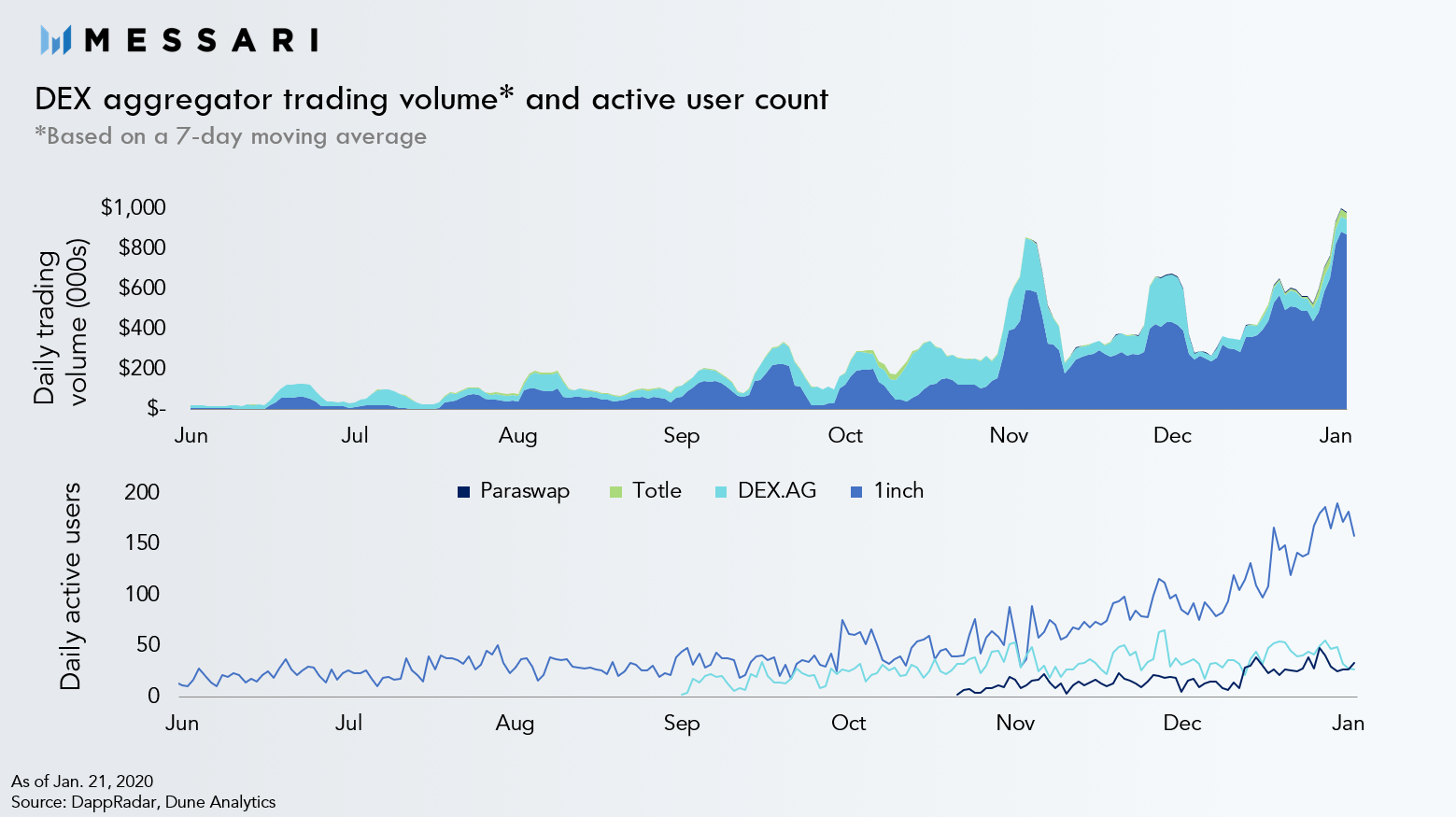
1inch is the clear leader accounting for between 85% and 95% of the total volume from DEX aggregators over the last month. In terms of users, it is also in the lead but by a lesser margin. Paraswap is at a disadvantage having launched two months ago but appears to just be catching up quickly. Although it doesn’t appear on the graph as a result of the averaging, on Jan. 21 it hit an all-time high of $20,000 putting it closer to volumes seen on DEX.ag and Totle.
From a user perspective, there are not many competitive features among DEXs. Traders will often flock to the exchange with the best prices and liquidity because they are purely profit-driven individuals. This bodes well for exchange aggregators as they can outcompete with any one exchange on these factors. Recognizing the potential for market capture, competition has already started heating up between DEX aggregators as jabs were taken after a distributed denial-of-service attack, only to be followed by another attack. This goes to show that open-source protocols meant to operate in adversarial environments need to be ready for well.... adversaries.
While there is benefit to working together as has been the case with many composable DeFi protocols, there will be times of fierce competition as teams duke it out in order to build a profitable business. These platforms are still in their nascent stage, but it appears they will be in a race to become the dominant aggregator in what could be a crucial piece of DeFi.
