Open Finance Fundamentals: Kyber posts strong month leading up to major upgrade

This report is part of a weekly series where we will explore the mechanics behind major Open Finance protocols and evaluate them on a fundamental basis. You can view prior reports here.
November was a big month for the entire decentralized exchange landscape as all-time high volumes were reached. In their monthly report, Kyber notes reaching a personal all-time high in a variety of categories including daily volume ($7.3 million), unique daily addresses (6,387) and total number trades (44,711).
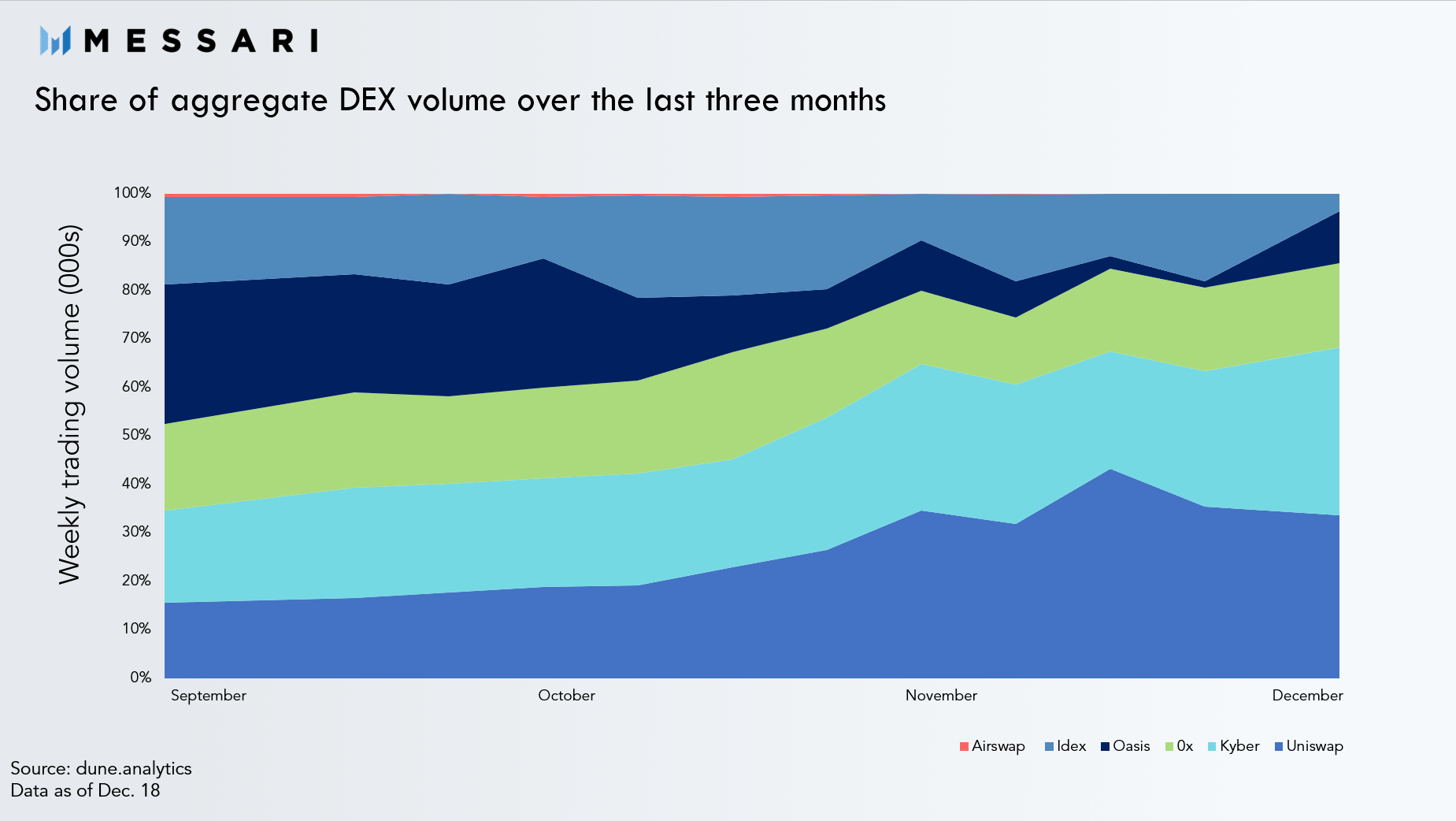
Over the last three months, Kyber and Uniswap have doubled their total market share from 30% to over 60% in terms of total volume across the major decentralized exchanges. This is part of a broader trend across DeFi, as peer-to-contract models have been beating out peer-to-peer order book models due to the increased ability to aggregate fractured liquidity and provide a seamless user experience on both the trading and capital aggregation side. The automated market maker models of these DEXs allow anyone with additional capital to provide it into a pool (or reserve in Kyber's case) and earn a return. This compares to order book models where liquidity providers need to be professional market makers with advanced risk frameworks.
Kyber's growth comes in the midst of a major protocol upgrade, known as Katalyst, that will impact the main three stakeholders
- KNC holders will be able to earn a portion of network fees by staking in the KyberDAO, which will decide the allocation of the rest of network fees between burning, staking rewards and reserve incentives
- Reserve managers will have fee-based incentives according to the number of trades and total volume they facilitate. They will also no longer need to maintain a KNC balance, removing a major pain point.
- dApp integrators will be able to set their own spread while the previous fee-sharing model will be eliminated.
These changes are intended to strengthen the incentives and improve the user experience of all network participants. While centralized exchange volume still dwarfs that of decentralized exchanges, DExs are slowly carving out a niche in crypto trading. As the benefits move beyond purely ideological, DEXs will be positioned to better compete with their centralized counterparts.
