Exciting in Both Good and Bad Ways: The Multi-Chain Future Will Be Regulated

The crypto industry was inspired by the burgeoning multi-chain world at Messari’s Mainnet 2021 summit earlier this week — and even the SEC couldn’t crush its spirits.
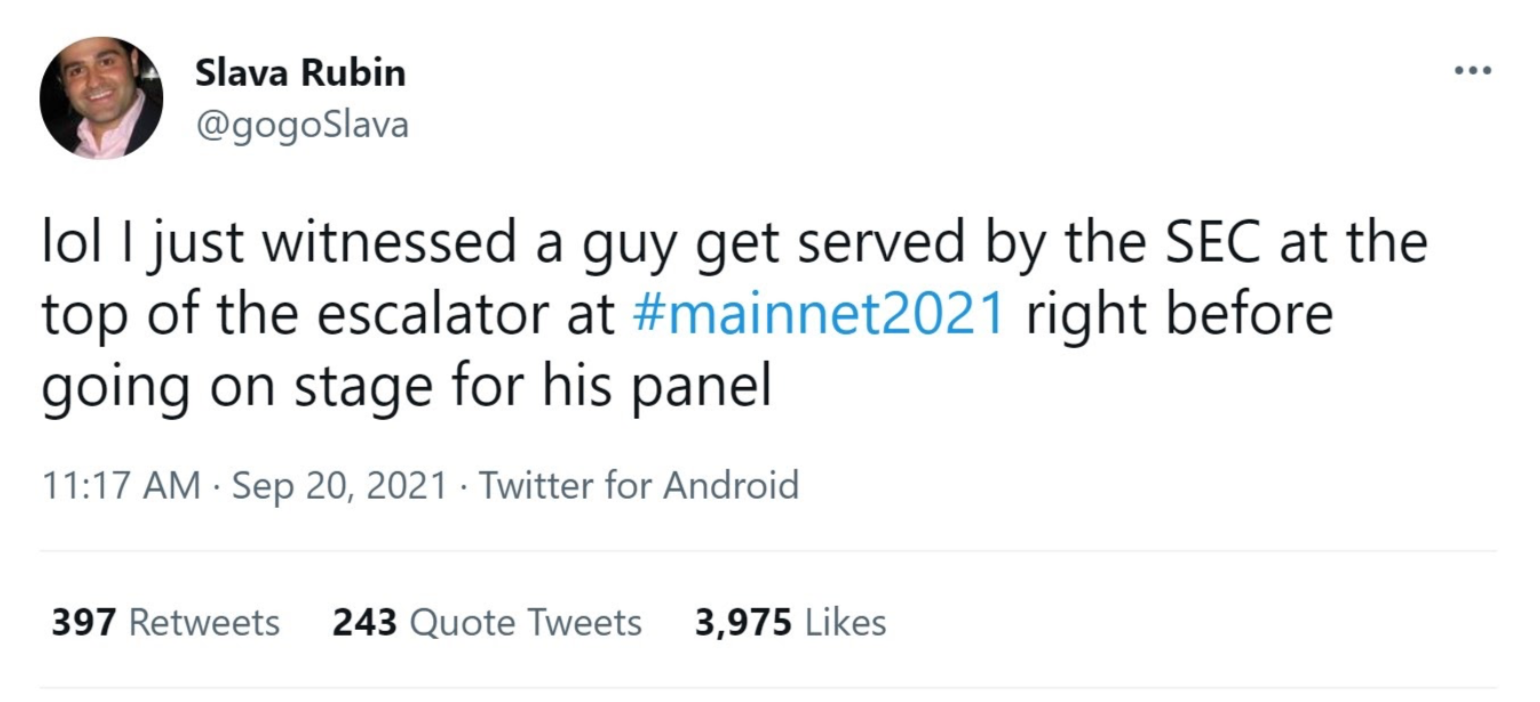
Over the three-day summit, September 20-22 in New York City, about +200 crypto luminaries took the stage to discuss the state of the industry. And on Day 1, Slava Rubin, the Founder of Indiegogo tweeted that he had watched a speaker get served by the SEC before that speaker took the stage.
It’s been a wild year for crypto. During the pandemic, as consumers were cooped up in their homes, crypto caught wider attention which pushed up the prices of many coins. From a first purchase of crypto to yield farming across DeFi protocols and minting NFTs, the crypto ecosystem has ballooned in the past year.
This ecosystem growth has not just been seen with Bitcoin and Ethereum, the top two cryptocurrencies by market cap, but also a whole slew of Layer-1 and Layer-2 blockchains.
Christine Brown, Crypto Chief Operating Officer and VP of Product Operations at Robinhood, believes this is a broader trend, not just contingent on the pandemic.
“There is a generational change happening right now in how [consumers] invest,” she said from the mainstage.
A Multi-Chain World
To that point, most Mainnet 2021 speakers agreed that this multi-chain world would continue.
“We’re increasingly living in a multi-chain world. We’re seeing increased usage on Ethereum, Solana, Avalanche. There’s so many ways to be productive with your capital,” Senior Research Analyst at Messari Ryan Watkins said on stage.
And for the industry, that has meant developing the infrastructure and bridges needed to make sure users can jump seamlessly on-chain, off-chain, and across chains.
While this multi-chain world has been exacerbated by the scalability issues on Ethereum, Tess Rinearson, the VP of Engineering at Interchain, which focuses on core development in the Tendermint and Cosmos ecosystem, said there are deeper, cultural shifts happening in crypto that has caused the move to new chains.
“You’re starting to see in the crypto and blockchain space, there’s a broader, more diverse group of people involved, there’s a broader, more diverse group of projects involved … and they’re going to want to choose technology that’s optimized for what they want to do,” Rinearson said from mainstage. “And that’s where you start to see these application-specific blockchains.”
Do Kwon, the Co-Founder and CEO of Terraform Labs, which launched the Terra blockchain the Cosmos ecosystem, agreed.
"Maybe it's a bad idea to stick all the applications into one global computer. Maybe it just makes sense to have a multi-chain future,” Kwon said.
And even the NFT space is going multi-chain. Devin Finzer, the Co-Founder and CEO of OpenSea, said the NFT marketplace is expanding to multiple blockchains. The company recently launched support for Polygon, a Layer-2 network of Ethereum for faster, cheaper transactions.
And on Day 3 of the summit, the talk was all about bringing on the next billion users — from the Gateways to Web3 for Institutions and Enterprises panel to a session featuring crypto luminary Balaji Srinivasan on the huge growth in the Indian market to the How NFTs Will 10x Crypto's Userbase panel, including Jeff “Jiho” Zirlin, the Co-Founder and Growth Lead at Sky Mavis, the company that built play-to-earn game Axie Infinity.
Basically, though, as more and more applications pop up on blockchain infrastructure, Robert Leshner, Founder of Compound Labs, said: “DeFi is not going to be called DeFi in the next five years. It’s just going to be called finance. All finance is going to run on blockchains. Most assets will make their way onto a blockchain.”
Incoming Regulations
But that won’t happen without a fight, it seems.
While not all regulators have been critics of crypto and blockchain technology, SEC Chairman Gary Gensler has been a bit of a boogeyman. From a livestream on September 21 that overlapped with Mainnet 2021, Gensler said that crypto tokens fit the definition of securities and “We have robust authority at the SEC and will use it.”
For this reason, there was plenty of talk at the summit about decentralization.
During a panel on the Proof of Stake stage, Kain Warwick, the Founder of Synthetix, said: "There's a component which we forget about which is the censorship in CeFi. If we want things resistant to regulatory capture and all kinds of interference then they need to be decentralized."
Chad Barraford, the Technical Lead at THORchain, echoed this in his sessions, stating that decentralization and a focus on multi-chain not only bring about superior user experiences but also acts as a defense against regulation.
“If we want to talk about DeFi, we have to talk about weed,” said Andre Cronje, the Founder of Yearn Finance and a developer on several DeFi projects. “And just like I would like to congratulate drugs on winning the war on drugs, I think five years from now we’ll have that same conversation, congratulating crypto for winning the war on crypto.”
Still, several speakers were interested in educating regulators on the technology so that rules aren’t created that put a damper on the innovation taking place in the space. For Mike Novogratz, the CEO of Galaxy Digital, it’s all about getting regulators to understand the importance of the space.
"We’re a $2 trillion industry now. This is an unbelievably fast-growing industry. It's growing 1.5x to 2x as fast as the internet in terms of adoption,” he said from mainstage. “You'd be an idiot as a politician to say, 'Oh we don't want that around.'”
Synthetix’s Founder, Kain Warwick said that most of the people in the space are aligned with regulators in trying to achieve open and fair markets and crypto is just a different toolset for that goal.
Perhaps best summing up why we’re all so excited about the growth of the space, Ethereum Co-Founder Vitalik Buterin said on mainstage:
"The reason why I call it the crypto space and not the blockchain space — even though I know calling it the crypto space is really imperfect — [is because] the space isn't just about blockchain, but taking the entire collection of cryptographic technologies and bringing them together in a common, interoperable ecosystem … where everyone is free to participate without relying on trusted and centralized intermediaries."
