Crypto treasury management: A look at the Tezos Foundation portfolio

The Tezos Foundation recently released its Second Biannual update, shedding some light on the Foundation's current portfolio and spending habits over the past six months.
In short, Tezos still holds a massive amount of capital (approximately $635 million), which stems from the project opportunistically raising over $230 million worth of BTC and ETH in the middle of a historic bull run. When put in perspective, the project can continue to hand out grant money at its current rate of $6.3 million per month for the next eight years (though this is likely down to six years now due to the recent market correction).
But what stood out in the report is the foundation’s active approach in managing its portfolio to avoid overexposure to the crypto markets. Since the last biannual update in Aug. 2019, the Tezos Foundation has liquidated around 7,500 BTC (calculated using the close price of BTC via OnChainFX), lowering the share of its portfolio dedicated to Bitcoin by 14%. Over the same period, the treasury’s share of more conservative investments, including USD, increased by a combined 6%.
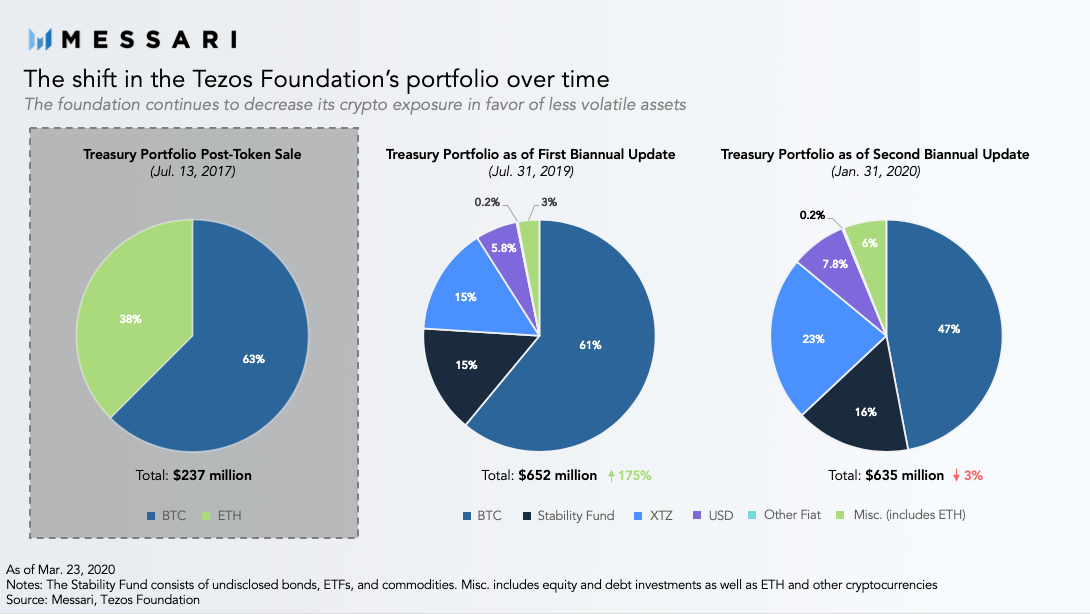
Why did Tezos dip into its Bitcoin reserves to help fund network development as opposed to just using cash?
It’s possible the foundation chose to offset its increased exposure to XTZ, which came from an appreciation in XTZ price (up 40% since Aug. 2019) and an extra 10.6 million tokens collected via baking rewards. The increase in price and network design left Tezos holding over $146 million in a high-risk asset, which, in theory, prompted the foundation to counterbalance the risk by upping its allocations of less volatile assets.
A diversified portfolio in action

Wilson Withiam was a Senior Research Analyst at Messari. Previously, he worked at Circle Research where he conducted research on cryptoassets. He graduated with a B.Sc. in Kinesiology and Exercise Science before studying computer science and economics at UConn.