Beware staking yields: The finances of proof of stake

Staking-as-a-service has been hot since Binance’s staking platformlaunched in September 2019.
The primary reason? Staking-as-a-service providers abstract away the technical requirements needed to validate aproof-of-stake (PoS) blockchain, allowing users to effortlessly collect staking rewards on their otherwise idle cryptocurrency holdings.
The timing of this launch was perfect. With PoS blockchains now storing over$10 billion of value, and a batch of new PoS blockchains coming online including the crown jewel Ethereum 2.0, PoS is set for a huge year. Seeing the writing on the wall, staking-as-a-service providers are falling over each other to attract user deposits, even as fees for staking services trend towards zero. The name of the game after all iscapital aggregation.
The promise of high single digit yields is extremely attractive in a worldstarved for yield, especially when those yields are positioned aspassive income. But buyer beware. Staking yields are not as they seem.
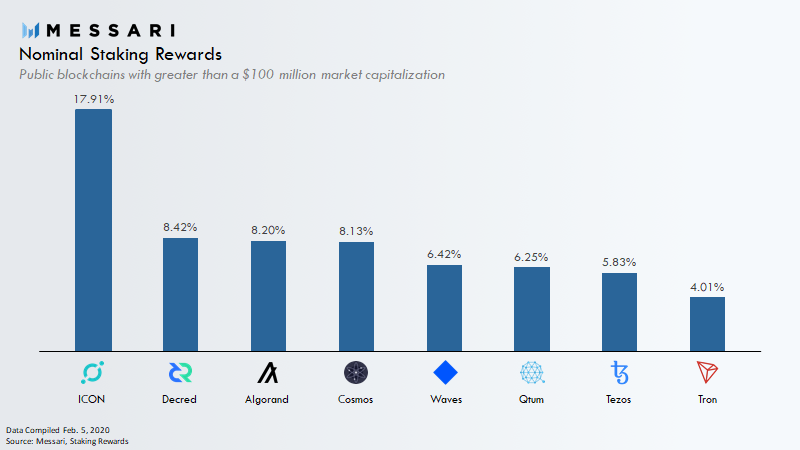
Staking rewards are wealth redistribution
Supply inflation does not create value; it is dilutive. This basic principle is one of the primary motivations for creating cryptocurrency in the first place: to prevent central banks from devaluing their currencies through supply inflation.

Ryan Watkins was a Senior Research Analyst at Messari. Previously, he worked at Moelis & Company as an Investment Banking Analyst where he worked on deals in the technology, telecom, and fintech sectors. Ryan graduated Magna Cum Laude from the Gabelli School of Business at Fordham University.