Alchemix: Bringing Future Yields to the Present

Launched just over a month ago, Alchemix has quickly amassed attention across the DeFi space. The team behind the project is pseudonymous, with its most prominent member being co-founder Scoopy Trooples. The protocol has attracted many speculators excited by the potential of “self-paying loans” and no liquidation risks. While this may sound too good to be true, DeFi has cemented itself as the launchpad for ideas that simply are not possible within the TradFi space.
With that being said, the prudent on-looker should peer below the surface of this project. Here, we look to understand the mechanics of the protocol, unpack what’s to come with v2, and explore growth and defense strategies the protocol may implement.
A First Lesson in Alchemy
Yield aggregators like Yearn Finance have been instrumental in providing steady returns across a wide variety of collateral, including stablecoins, wrapped BTC, and ETH. These yield aggregating platforms implement sophisticated strategies, allowing for user friendly set-it-and-forget investment opportunities. The Alchemix protocol is designed as a unique and creative extension of the functionality created by yield aggregator vault strategies.
From a functional perspective, the protocol allows for future yield to be tokenized in the form of a synthetic, alUSD. Users may deposit DAI into Alchemix which then deploys deposited Dai into the Yearn Finance v2Dai vault, and simultaneously allows users to mint, in the form of alUSD, up to 50% of the deposited amount. As yields are returned from Yearn Finance, the Alchemix treasury is allocated 10% of the yield while the remaining 90% is positioned to pay down alUSD debt.
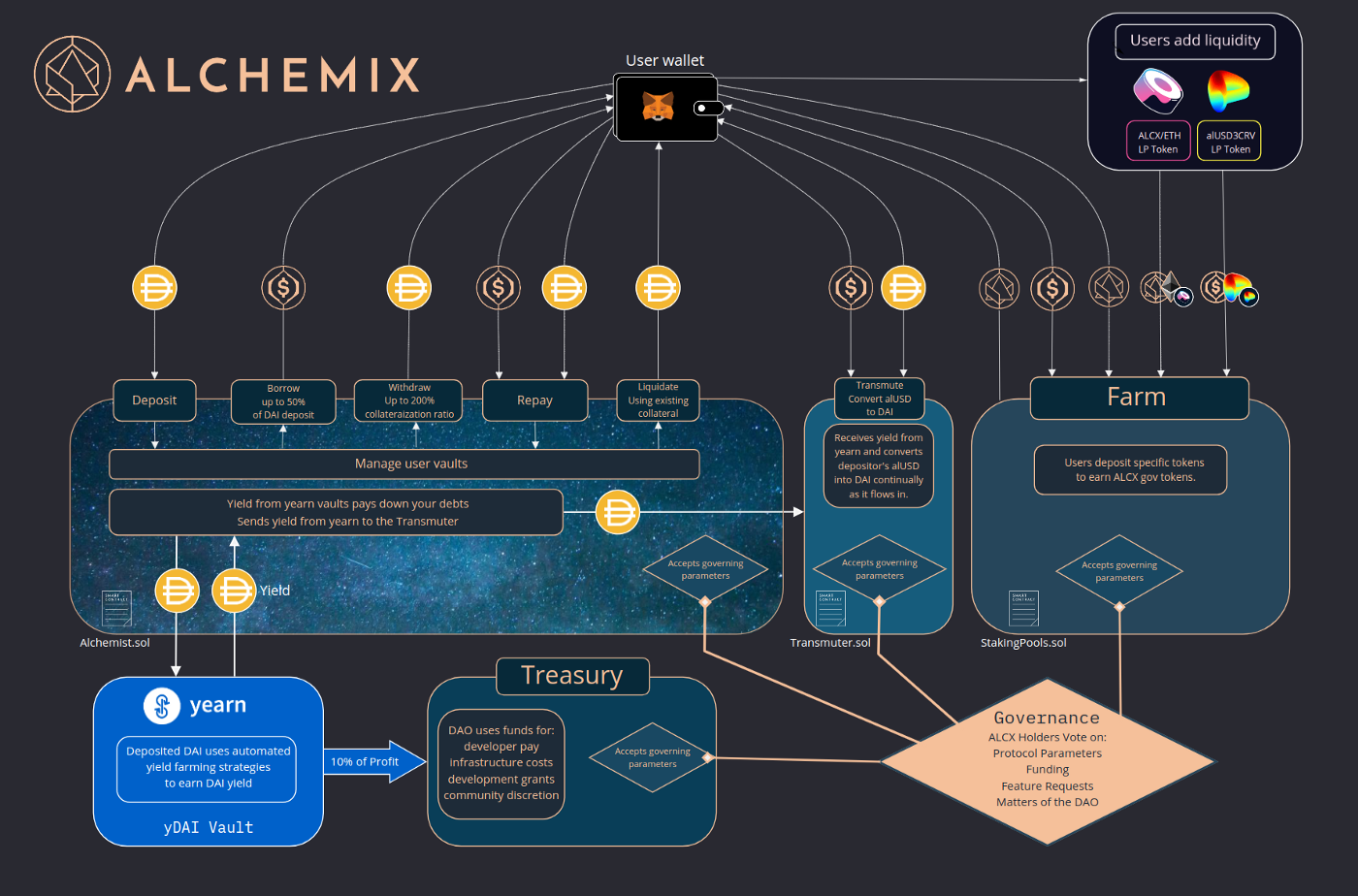
Source: Alchemix Medium

Prior to joining Messari, Seth worked in traditional finance software and services, and has a MSc in Applied Mathematics. Seth is a Senior Research Analyst on the Enterprise Research team, and focuses on infrastructure, verifiable compute, and the AI x Crypto intersection.